Emerging Next-Gen 5G Streaming Architecture Has Major Implications for Content Providers
Table of Contents
Red5 to Foster Access to New Capabilities on its Universal Streaming Platform
Introduction
Amid 5G’s unrelenting gains as a conduit for video streaming, new developments taking shape with carrier conversions from Non-Standalone (NSA) to Standalone (SA) infrastructures have major implications for everyone streaming content through 5G connections.
Much has been written about the slicing capabilities associated with 5G SA as defined by 3rd Generation Partnership Project (3GPP) specifications. But there’s been far less focus on specifications defining 5G Advanced Media Streaming Architecture (MSA), which is integral to getting the best possible streaming performance with the use of dedicated virtual circuits created by slicing mechanisms.
Unlike how streaming works over wireline networks, where the media and transport layers operate independently of each other, 5G MSA as part of the latest specifications released by 3GPP under the 5G Advanced label, functionally integrates media and transport layers in ways that orchestrate how network components are used to support specific media applications. But 5G MSA isn’t a new streaming format.
Instead, it’s comprised of a hierarchy of application program interfaces (APIs) with elements controlling 5G network operations that provide third parties direct access to 5G SA functionalities that can be used to optimize support for their streamed content no matter what streaming format they’re using or what the use case might be. This means outsiders can maintain their positions as independent providers using 5G connectivity free of the best-effort dependency they’ve had to live with up to now or, alternatively, without the heavy lifting and costs they had to endure with one-off integrations to enable better QoS performance over each CSP’s infrastructure.
Paralleling the motivations that spawned the open-source software movement, communications service providers (CSPs) serving as mobile network operators (MNOs) and often using 5G as a fixed wireless access (FWA) pipeline are relaxing the proprietary controls they have long exercised in creating their own, largely failed high-performance streaming services. The 5G MSA initiative is just a piece of a larger 5G Advanced agenda aimed at making 5G mobile and FWA a far more inviting environment for third parties to work in, which is CSPs’ best hope for making the investment in 5G worthwhile, according to a report issued by McKinsey & Co.
“Although telcos invested nearly $1 trillion in network upgrades since 2018, they are still struggling to monetize 5G,” McKinsey wrote. “The sector is now at risk of losing out on the chance to extract significant value from 5G’s unique capabilities, much as it has missed the opportunity from streaming video and enterprise messaging over the past 20 years.”
By relying on monetization models that leverage the new API ecosystem emerging with 5G Advanced, CSPs have the potential between now and the 2029-2031 timeframe to “unlock $100 billion to $300 billion in connectivity- and edge-computing-related revenue for operators while generating an additional $10 billion to $30 billion from APIs themselves,” the report said. However, as McKinsey also suggests, if CSPs don’t proceed aggressively with building out the supporting elements, including deal-making templates as well as the API infrastructure, up to two thirds of that value creation could go “to other players in the ecosystem, such as cloud providers and API aggregators.”
In other words, one way or another, the marketplace unfolding through 5G Advanced and MSA is a wide-open global gold mine that’s sure to redefine the wireless business as it’s been structured up to now. “In addition to enhancing today’s use cases, network APIs can lay the foundation for entirely new ones,” McKinsey said.
“Remotely operated equipment, semi-autonomous vehicles in production environments, augmented reality gaming, and other use cases could create substantial value in a broad range of industries,” the report continues. “By enabling these innovations, telecom operators can position themselves as essential partners to enterprises seeking to accelerate their digital transformations.”
The implications are profound for everyone putting video streaming to commercial use, including entities in the M&E market who are used to concentrating on wireline broadband as their primary routes to end users. With the higher bitrates and more reliable coverage enabled by 5G New Radio (NR) technology, MSA has the potential to tilt streamed-media user experiences in favor of wireless over wireline access.
Consequently, from a content provider perspective, 5G should no longer be thought of as just a mobile technology. It’s also a force to be reckoned with when it comes to reaching devices, including handsets, that are connecting over fixed access networks, which is invariably the case when users aren’t out and about.
Our purpose here is to explain 5G MSA and its implications for the streaming ecosystem at large while describing Red5’s role in ensuring customers the maximum operational efficiency they’ll need as they exploit opportunities in the multi-faceted streaming environment to come. We begin with a look at where things stand today with the use of 5G mobile and FWA infrastructures in video streaming.
Part 1 – The Accelerating Impact of 5G
Recent research reports offer varying assessments of global video streaming market size and how market share is divided across service categories and user devices. But they all agree the market is booming with no end in sight. In Figure 1 we’ve cited findings from two sources that fall within consensus ranges on these points.
While, according to Ericsson’s latest Mobility Report issued in conjunction with the Global Mobile Suppliers Association (GSA), the global 5G subscriber count has surged to 3.1 billion in the seven years since 5G rollouts began in 2019, up to now video streaming as experienced by the vast majority of those subscribers has primarily been distinguished by the visual quality gains enabled by higher 5G bitrates. But that’s beginning to change at an accelerating pace as carriers move beyond the non-standalone (NSA) 5G implementations that have dominated the early years (see Figure 2).
Current and projected global 5G subscriptions
Q1 2026
Q4 2027
Q4 2031
SA and NSA combined
3.1B
4.1B (projected 4G total)
6.4B (two-thirds of projected mobile subscriptions)
5G NSA functionality is limited by the fact that deployments rely on existing 4G LTE Evolved Packet Cores (EPCs) to support 5G radio access networks (RANs). In contrast, 5G SA requires a major rebuild extending from installation of new EPCs to placement of small cell access points deep enough in service areas to minimize high-traffic congestion and to accommodate the shorter signal reach associated with MNOs’ use of spectrum in the millimeter band above 20 GHz.
According to the GSA report cited in Figure 2, mobile and FWA device manufacturers are rapidly expanding support for 5G SA with 2,518 different device models now commercially available, marking a 33.7% increase from YE 2024. GSA notes many employ new chipsets like MediaTek’s Dimensity 9500 and Qualcomm’s Snapdragon 8 Elite Gen 5 to strengthen support for advanced features.
Anchored by a cloud-native 5G Core, 5G SA enables faster, more agile service orchestration with greater spectral efficiency generating higher uplink and downlink data rates. Key benefits include a reduction in latency contributions of RAN processing to 1ms through what’s known as Ultra Reliable and Low Latency Communications (URLLC), wider coverage through multi-spectrum band aggregation, and in slicing entailing delivery of logically independent virtual circuits within and across spectrum bands with the ability to customize performance parameters for multiple use cases.
The FWA Factor
Things have moved far enough with 5G SA buildouts to merit a close look at what a global 5G foundation means to the broadband services market, considering how rapidly 5G FWA is being positioned to compete with wireline networks (see Figure 3). For the first time, FWA has the potential to match the performance parameters achieved over wireline networks, including fiber-to-the-premises (FTTP) connections.
Metric
June 2025
November 2025
June 2026
Total FWA providers in operation
241
Share of FWA service providers using 5G
51%
65%
71%
Top three 5G FWA regions
North America
Nordic states
Gulf states
Latest additions to 5G FWA launch list
Algeria; Argentina; Bangladesh
Morocco; Taiwan
Turkey; Vietnam
Projected global population with 5G FWA coverage by 2031
Our point here isn’t to make a case for 5G FWA versus other broadband access technologies or to suggest which ones will gain the most subscribers in the years ahead. Rather, we simply want to emphasize how important the 5G Media Streaming Architecture (MSA) emerging with 5G Advanced implementations over 5G SA networks will be to providers of streamed video in the consumer marketplace as they seek to maximize their market reach and flexibility in the years ahead.
As researcher Opensignal notes in a recent report on mobile 5G performance, “Direct to device (D2D) service only takes effect when a user is outside the range of traditional terrestrial networks.” In other words, 5G performance metrics that matter relating to consumer media consumption as compiled by Opensignal “primarily reflect every day on-network usage.”
Consequently, before diving into the details of what’s entailed with 5G MSA, it makes sense to take a look at where things currently stand with 5G FWA performance as measured against the other fixed access platforms, recognizing the FWA metrics will get better, not only with implementations of 5G Advanced capabilities but especially with the availability of more spectrum. As Opensignal says in its mobile report, “While nationwide 5G SA availability is a necessary foundation for advanced services, it has a more limited impact on user experience metrics than gains in spectrum depth or network capacity.”
Currently, FWA performance in the U.S. and elsewhere is restricted by MNOs’ prioritization of their operationally optimal mid-band holdings for mobile usage, leaving much of the current 5G FWA coverage impeded by the propagation distance limitations imposed by reliance on higher frequencies allocated to them at the 6 GHz tier and the millimeter wave frequencies above 20 GHz. But regulators worldwide, recognizing the need to leverage low-cost FWA to extend broadband into underserved areas, are moving to free up more spectrum in the lower tiers.
In the U.S., FWA performance could improve dramatically in the years ahead, depending on which MNOs benefit from winning bids in the Upper C-Band spectrum auction the FCC has slated for July 2027. The commission intends to auction eight 20 MHz upper C-band blocks between 3.98 and 4.14 GHz for what it calls “terrestrial wireless flexible use” under licensing that would allow seamless integration with winning bidders’ lower C-band block holdings. This would create an integrated 440 MHz “super band” with 3,248 flexible use licenses tied to specific service areas across the country.
While other U.S. carriers have indicated varying degrees of interest in FWA as a backup to wireline broadband, T-Mobile, billing itself as the “un-carrier,” is the only one among the big three who’s all in on FWA at this point. Lightreading recently reported the carrier has updated its FWA signup projections with anticipated growth from 8.5 million subscribers at YE 2025 to 15 million by 2030.
With a FWA footprint covering 70 million U.S. households, T-Mobile was outpacing all other providers in broadband subscriber growth as of Q1 2026, according to the industry trade publication RCR. Given the intensity of competition and the much higher costs of deploying FTTP, it remains to be seen whether Verizon and AT&T will stick to their fiber-centric agendas. But T-Mobile CEO Srini Gopalan was right about FWA when, as reported by Lightreading, he said, “The days of asking the question, is this here to stay? Those are gone.”
No matter how things go in the U.S., as reflected in Figure 3, FWA deployments are surging worldwide. Factoring in performance gains that will be coming into play with implementations of 5G Advanced, it’s safe to say that any comparison of how 5G FWA currently stacks up against wireline broadband will soon be outdated. But a look at what’s already been accomplished with FWA does offer a hint of what’s in store.
According to metrics Opensignal has compiled covering broadband deployments (Figure 4), while there are significant gaps between T-Mobile and the other top U.S. broadband providers in the case of downlink and uplink speeds, the differences across all the other measurement categories are amazingly small, including most dramatically video experience, where just 3.3 points on a 1-100 scale divide the top ranked Xfinity wireline network and T-Mobile’s FWA network. Similarly, the gap in consistent quality between Xfinity at the top and T-Mobile in last place is just 4.9 points.
Another aspect to how close 5G FWA is to the wireline side can be seen in reliability scores measured on a different scale, where all five providers are above 600. According to Opensignal, 600+ scores line up with user-generated assessments of their home internet connections as highly reliable, which, the researcher says, “means the connection has either never dropped or dropped very infrequently and service has been sufficient for usual activities almost all the time.” Opensignal said T-Mobile’s score was up 58 points from a year earlier.
Part 2 – 5G Advanced & Media Streaming Architecture
Now with growing numbers of carriers worldwide reporting they have reached high levels of 5G SA coverage on mobile and FWA networks, the next step is implementation of 5G Advanced. All the benefits achievable with 5G SA are aggregated for application with 5G Advanced under the set of 3GPP specifications in Releases 18 and 19, the last of which were published in 2025.
While the software stacks supporting 5G Advanced have already been deployed by some carriers, including T-Mobile, which in April 2025 announced it was the first to implement 5G Advanced architecture nationwide, it’s only now in 2026 that the marketplace can begin witnessing what this means in real-world operations. But the changes will be felt quickly, especially in the case of 5G FWA networks.
5G Advanced and the Coming of 6G
By virtue of operating in fixed mode as opposed to the more operationally complex mobile environment, implementations of 5G Advanced over FWA are easier and less costly to accomplish, which, according to the Opensignal report cited in Figure 2, means that carriers installing 5G Advanced support are largely focused on FWA, often leaving the mobile use case activations for later. With 5G Advanced in operation, these networks pose a significant threat to wireline operators with service orchestration intelligence delivering live-streamed user experience (UX) that’s hard to match in the wireline domain.
Indeed, what’s taking shape will likely serve as a foundation for media operations over both fixed and mobile 5G networks well into the future. That includes the 2030s when 6G specs are activated to put 5G Advanced to work in new ways by moving beyond use of AI as an add-on feature.
5G Advanced is becoming the industry baseline, and its service-based, cloud-native core is why it lasts: 3GPP is evolving that same core toward 6G rather than replacing it wholesale. For streaming providers, that makes it a durable foundation for converged delivery across cellular, fixed wireless, broadcast, and non-terrestrial networks.”
– Andrew Towe, 5G Broadcast and Media Streaming Standards Specialist.
Once 6G is up and running on that 5G Advanced foundation, cloud-native AI integration with network intelligence will allow the network to learn and adapt in response to changing use-case dynamics. And, as new spectrum allocations open space for implementations of 6G RAN usage for better performance at the millimeter wave and other spectrum tiers, the 5G spectrum sharing enabled by Dynamic Spectrum Sharing (DSS) will be expanded to include 6G via the new Multi-Radio Access Technology Spectrum Sharing (MRSS) mode that’s now part of the 5G Advanced specs.
As currently defined, 5G Advanced encompasses a wide range of capabilities that combine with the MSA specifications to create a high-potency video streaming environment, starting with the application-specific flows enabled by slicing. Slicing allows MNOs to get past the inherent unpredictability of wireless connectivity by meeting the high-performance requirements of circuits where there’s a payback for the extra effort that goes into that.
This brings into play as-needed utilization of advanced capabilities like low-latency, low-loss, scalable throughput (L4S), DSS and MRSS, and dynamic resource allocation to AI applications, which, as mentioned, will be operated from the core EPC with 6G. Notably, some 5G Advanced functionalities are well-tuned to delivering support for immersive services tied to extended reality (XR), cloud gaming and video communications interactivity during live events.
The 5G Media Streaming Architecture
All of this dovetails with 5G MSA, which frees content providers from having to negotiate proprietary CSP integrations if they want to benefit from the stream-specific applications of 5G Advanced. Now CSPs have a standardized approach to facilitating such engagements with the modular flexibility to build collaborations around which of the many functions relating to QoS, CDN-equivalent features, traffic handling and other features are activated through the platform’s APIs in either unicast or broadcast/multicast modes.
In the case of QoS, the specifications have gone to a level of network control granularity that manages the IP packet sets comprising individual video frames with enhancements in traffic detection and QoS flow mapping. In what is called “Content Hosting,” the specifications enable use case-specific control over ingest protocols and formats, caching and proxying of media objects, content preparation, access protection, and determining target distribution areas (e.g. through geofencing). And, with regard to trafficking, the technology delivers more information on traffic patterns related to timing, end of data bursts and other dynamics while extending the ability of user equipment (UE) to manipulate traffic handling policies during an ongoing streaming session.
All of this is accomplished through functionalities segmented for downlink and uplink implementations on CSP networks with minimal disruption to content providers’ streaming platform workflows. The essential ingredient is, those providers need to have access to all the APIs third parties are supposed to use as the means of interacting with any MNO network that has been equipped to support 5G MSA.
Once they’re able to use those APIs, the software modules can be employed for any streaming scenario based on terms negotiated with individual MNOs, from mass market M&E deployments to use cases beyond mainstream consumer video applications, such as smart city, industrial and emergency surveillance, remote healthcare, education, working training, robotics and much else. We’ll delve deeper into the API aggregation processes in Part 3.
Here we’re focused on how 5G MSA works.
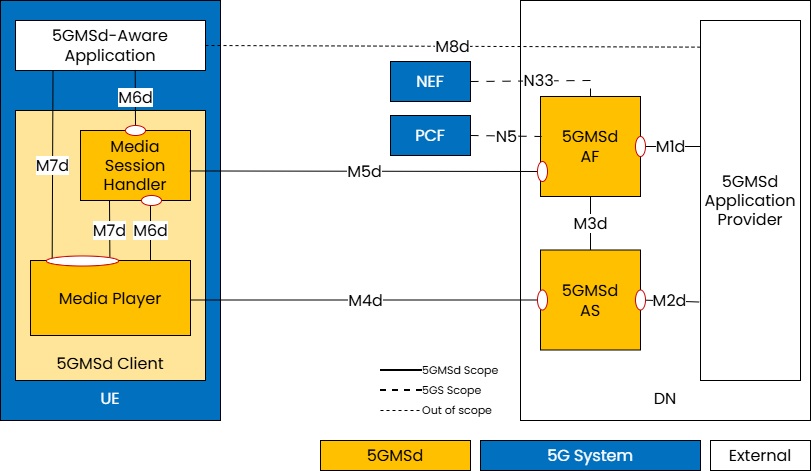
As illustrated in the accompanying diagram (Figure 5), which is devoted to downlink operations but can be applied to uplinks as well, the 5GMS-Application Function (AF) and Media Server (MS) residing in the carrier’s 5G core network interact via open APIs with the content supplier, labeled 5GMS-Application Provider (AP), to capture information describing the encoding, rights management, packaging, metadata and other elements defining performance parameters in the provider’s application layer.
The 5GMS-AF triggers provisioning of media session policies by the 5G system’s Policy Control Function (PCF) and network responses pertaining to managing QoS and traffic steering through the system’s Network Exposure Function (NEF). At the same time, the 5GMS-AF conveys the AP’s data set to the 5G Client’s Media Session Handler, which coordinates setting up and managing sessions and collecting quality of experience (QoE) and consumptions metrics on the User Equipment (UE).
The same application layer data is transmitted from the 5GMS-AP through another API to the 5GMS Application Server (AS), which communicates directly with the 5GMS Client’s Media Player to fetch and play the media stream. The actual moment-to-moment operations of the session stream are enabled by the logic conveyed by the AP through a streaming service known as the 5GMS-Aware Application.
Messaging also flows through many other designated interfaces to coordinate:
configuration and provisioning between AF and AS,
ABR profile selection and other media player processes,
content protection,
processing and caching by CDNs or 5G’s Edge-enabled 5GMS Application Server (EAS),
performance monitoring,
and much else specific to the streamed session requirements on downlinks and uplinks.
Figure 5. 5G Media Streaming Architecture: Downlink Operations. Source: 5G Media Action Group.
In this diagram illustrating the downlink operations of 5G MSA, the 5G platform is linked to the content provider, identified as the Application Provider, through two M-labeled APIs – one (M1) to the Application Function (AF) that provides messaging pertinent to the 5G Network (NEF), the Policy Configuration (PCF) and the client-side Media Session Handler, and the other (M2) to the Application Server (AS) that communicates via the M4 interface with the client-side Media Stream Handler. Coordination between the 5GMS AF and AS is maintained by communications over the M3 interface, while the other M-labeled interfaces support messaging among components in the 5G client residing in the User Equipment (UE).
The Real-Time Communications Architecture Component in 5G Advanced
Adding to the new standardized approach to optimized streaming over 5G, 3GPP has introduced specifications supporting real-time video communications with the use of WebRTC. Referenced as Real-time Media Communications Architecture (5G-RTC), the idea is to use the same architectural elements defined by 5G-MSA for RTC, substituting RTC Application Provider for Media Application Provider with the RTC AF as one realization of the general Media AF and similar roles accorded to the RTC AF, RTC Client, and Native WebRTC App vis a vis, respectively, the Media AF, Media Client and 3rd party Media-Aware Application.
From an architectural perspective, the biggest difference is that, with 5G-RTC, the Client is an end point in WebRTC connectivity that is supplied by the Application Provider. But, essentially, the idea is to provide users a two-fold path to incorporating their WebRTC into 5G streams: either as standalone real-time communications services or as real-time peer-to-peer communications adjuncts to general streaming applications that employ of 5G MSA.
In all cases, 5G-RTC is meant strictly as a way to support use of WebRTC in 5G networks in conformity with the basic standard with no intention to integrate the architecture with platforms like the Red5 Experience Delivery Network (XDN) that use additional techniques to enhance scaling and applications versatility with WebRTC. But 3GPP has taken another step toward bringing 5G together with highly scalable real-time streaming as supported by XDN Architecture and the world at large through implementation of rudimentary support for the MOQ Transport standard.
In this case, the latest 3GPP 5G Advanced specifications make it possible for the 5G system to obtain metadata pertaining to MOQT operations from encrypted traffic. This automates MNOs’ ability to treat the content as MOQ traffic in cases where they have configured what’s known as user plane functions in their networks to support MOQ relay functionality. Otherwise, as mentioned earlier, content packaged for streaming over MOQ will be treated at the media layer when it comes to delivery over 5G networks like all other streamed media with the 5G Advanced options available to 3rd parties in cases where MNOs have implemented 5G MSA.
Part 3 – Enabling 3rd Party Use of 5G MSA
There are many approaches streaming application providers can take to equipping themselves with the APIs they’ll have to use in unlocking the capabilities of the 5G MSA. While a rudimentary API ecosystem, including contributions from CSPs themselves, has emerged as part of the generalized Programmable Network Architecture established for 5G SA, the APIs central to executing the elements described in Figure 5 for 5G MSA have yet to become a significant segment of that ecosystem.
The Emerging CSP API Ecosystem
Up to now, the mobile industry’s collaborative focus has been on development of a 5G Advanced API ecosystem that’s primarily meant for enterprises operating over private 5G networks. That activity is organized through two initiatives, beginning with coordination of API development by the Linux Foundation’s CAMARA project. Once certified for commercial use, the APIs are made available to users through the GSMA Open Gateway23 Initiative.
All three of the top U.S. mobile carriers along with Orange, Telefonica and Vodafone and two vendors, Ericsson and Nokia, comprise the Premier membership tier of CAMARA. These CSPs and most other major carriers globally are participants in the GSMA Gateway
These initiatives attest to how important private networking has become to monetizing CSP infrastructure. The rapid spread of private 5G networks leverages the core infrastructure built by CSPs either with local access extensions dedicated entirely to enterprise uses or through shares of the public 5G access network capacity that are dedicated for private use.
Most APIs offered so far through GSMA Gateway23 are targeted to generalized applications like authentications, location services, real-time communications, QoS profiling and connectivity, device information, computing services and financial arrangements rather than the APIs specifically defined for 5G SMA. Commercially viable use cases enabled by these APIs that have gone into play since 3GPP issued its final set of 5G Advanced specs involve things like autonomous vehicle operations, fraud detection in insurance claims, airport general operations, security and baggage handling, delivery service operations and retail store connectivity. The three exceptions with M&E implications have to do with edge network detection for immersive game playing and support for immersive large events and remote venue connectivity.
Unmet Broadcaster Demand for 5G MSA APIs
But when it comes to facilitating use of APIs for 5G MSA operations over public networks, efforts on the part of CSPs have been sporadic at best. Nonetheless, it’s inevitable there will be a need for aggregations of 5G MSA APIs that eliminate burdensome DIY development now that CSPs have reached the point in their buildouts where they can pursue shared public network opportunities enabled by the 5G Advanced specifications.
One immediate source of demand pushing carriers toward support for 5G MSA is the transition by over-the-air TV broadcasters worldwide to the next-gen transmission capabilities embodied in standards like ATSC 3.0 and DVB-1, which support delivery of streamed mobile video paired with TV channels over the TV broadcast spectrum. This is enabled by 5G Advanced specifications that extend reception of mobile services to standalone receivers used for over-the-air reception of next-gen TV signals.
According to a market report on global 5G developments produced by researcher IMARC Services, field trials leveraging 5G NR technology led by Qualcomm and German electronics giant Rohde & Schwarz across the U.S., U.K., Germany, and South Korea have created premium opportunities for free-to-air mobile TV that are now in various stages of implementation. The researcher cites ATSC 3.0 as a primary growth driver for 5G NR technology in the U.S. and notes 5G broadcasts unrelated to TV broadcast are utilizing the new specifications across China and India.
Part 4 – Red5 Support for Capitalizing on 5G Advanced
As of mid-2026, it’s too soon to assess exactly where all this will lead once 5G MSA is activated on 5G networks. But as CSPs move in that direction, our commitment at Red5 is to make access to 5G MSA readily available to our customers in whatever way or ways best serve their interests.
Building on Long-Standing Engagements with 5G Use Cases
Providers of in-venue viewing experiences, including The Famous Group and multiple sports and concert producers across the U.S. and beyond, are leveraging XDN Architecture to deliver a wide range of approaches to in-venue streaming. They’re using the Red5 platform to stream camera flows and feature enhancements, including augmented-reality (AR) experiences in many instances, from production centers to 5G and other in-venue wireless access points for A/V distribution to handhelds in perfect sync with what’s unfolding live.
On another track, Red5 is facilitating ultra-low latency streaming over 5G through connectivity of live-streamed content to 5G sites directly linked to the AWS global cloud via AWS Wavelength Zones. As the only real-time streaming supplier authorized for pre-integration with Wavelength, Red5 makes it possible for streamed content to avoid delay-producing internet hops in transit to the 5G data aggregation centers serving as AWS on-ramps.
Now, given all the developments discussed so far, it’s clear there’s a need to facilitate use of 5G MSA with the platforms we’ve developed to unify stream orchestration, packaging and playback for next-gen streaming operations in the complex multi-transport environment. Whether we do this through in-house MSA API development and aggregation, engagement with third party suppliers, or with deference to availabilities from CSPs depends on what will work best for our customers once CSPs begin activating 5G MSA.
The Red5 Universal Streaming Environment
Meanwhile, we’re proceeding with all the other initiatives we’ve announced over the past year that contribute to the multi-protocol streaming platform we’ve created with our support for the new MOQ standard. Where MOQ is concerned, we are working with a growing number of customers who are beta testing operations over the global CDN infrastructure instantiated with our partner CacheFly.
With the IETF nearing completion of the foundational MOQ Transport standard, we’ll soon be moving to commercial operations as we continue to expand our affiliations in the buildout of next-gen CDNs. In so doing, we’re prioritizing setups with CDN partners that will leverage XDN Architecture in the orchestration of cloud processing resources to enable point-and-click activation of streaming over any of the leading streaming protocols, including the currently prevailing HLS and DASH modes as well as the leading real-time streaming platform WebRTC.
With MOQ we’re opening the door to a less complex and, we anticipate, soon to be more widely adopted approach to what we’ve accomplished with WebRTC in enabling customers to stream payloads multi-directionally at any distance and scale with end-to-end latencies registering at 250ms and under. Along with benefitting from the dynamically adjustable latency levels enabled by MOQ, which, along with sub-500ms real-time streaming include streaming in the two-second and five-second latency ranges, Red5 customers utilizing these next-gen CDN infrastructures have the flexibility to transform ingested HLS- and DASH streams for transmission over MOQ to end users or to convert MOQ to the HTTP formats at CDN outputs to end users.
Paralleling the real-time transport versatility, we’ve taken our commitment to multi-format flexibility into the media layer with introduction of the Red5 Video Packager and our Playa client player, which can be employed in any streaming environment whether or not transport is provided by Red5 and its CDN partners.
As described in this blog and at greater depth in this white paper, the Red5 Video Packager is a cloud-mounted software platform used in conjunction with our transcoding technology to orchestrate use of cloud resources to handle the processing that goes into preparing payloads for ingestion onto origin servers for distribution over CDNs. This ultra-low latency processing and cost-saving cloud resource orchestration achieves desired results no matter whether payloads are streamed via HLS, Low-Latency HLS, MPEG-DASH, Low-Latency DASH, WebRTC, MOQ or RTSP.
Playa, which the OpenMOQ Software Consortium has endorsed as a template that can be used to develop players suited to any MOQ use case, can be used for playback of conventionally streamed content as well as content streamed over our MOQ Transport implementations. Or customers using the Red5 Video Packager in other streaming environments can rely on any other players suited to whatever streaming modes they’re using.
Conclusion
With all the opportunities embodied in the explosion of technologies aimed at adding new dimensions to streaming performance over mobile and fixed networks, providers of streaming services and applications face unprecedented levels of complexity on the road to exploiting these new capabilities. CSPs’ forthcoming activation of 5G MSA allowing third parties to leverage the integration of network and media layer functionalities in support of any use case will significantly add to both the opportunities and complexities providers face in the years ahead.
Red5, with its expansion of real-time streaming support into the new MOQ domain and introduction of a packaging platform supporting any streaming format, has already gone a long way toward eliminating the complexities endemic to operating in the next-gen streaming environment. We’re bringing the same commitment to saving time and cutting costs into our preparations for the availability of 5G MSA.
As our customers shape strategies aimed at enhancing streaming performance through the power of integrated network and media layer functionalities over both FWA and mobile 5G networks, they can be sure they’ll be able to take advantage of these capabilities with maximum efficiency on the converged streaming platform we’ve introduced with the Red5 Video Packager. Stay tuned as we update you on these developments and feel free to contact us any time for more information.
The Red5 Team brings together software, DevOps, and quality assurance engineers, project managers, support experts, sales managers, and marketers with deep experience in live video, audio, and data streaming. Since 2005, the team has built solutions used by startups, global enterprises, and developers worldwide to power interactive real-time experiences. Beyond core streaming technology, the Red5 Team shares insights on industry trends, best practices, and product updates to help organizations innovate and scale with confidence.
By Red5 Team
The Red5 Team brings together software, DevOps, and quality assurance engineers, project managers, support experts, sales managers, and marketers with deep experience in live video, audio, and data streaming. Since 2005, the team has built solutions used by startups, global enterprises, and developers worldwide to power interactive real-time experiences. Beyond core streaming technology, the Red5 Team shares insights on industry trends, best practices, and product updates to help organizations innovate and scale with confidence.