Table of Contents
Most conversations that I’m aware of around MOQ (Media over QUIC) focus on media and entertainment. Live sports, fan engagement, betting, and interactive broadcasts tend to dominate the headlines. However, MOQ streaming for surveillance and monitoring, drone & IP camera streaming, and public safety & defence are some of the most compelling applications for MOQ. Here are five reasons why.
1. Simpler connection management
When using WebRTC, one of the biggest operational challenges in large-scale real-time deployments is connection setup. WebRTC works extremely well for interactive communications, but it also comes with ICE negotiation and other complexities. Many surveillance workflows are much simpler. Cameras publish streams and operators subscribe to them. MOQ has the potential to simplify that architecture considerably.
2. Built for scale without sacrificing real-time performance
One of the biggest advantages of MOQ streaming for surveillance and monitoring is its ability to scale across hundreds or thousands of video sources without sacrificing real-time performance. Surveillance and monitoring deployments often involve hundreds or thousands of cameras distributed across cities, transportation networks, industrial sites, and public safety systems. These systems usually use RTSP- or other TCP-based video delivery protocols. MOQ combines real-time latency with the scalability traditionally associated with CDN architectures. By leveraging QUIC instead of TCP, it avoids issues like head-of-line blocking that can slow delivery in congested networks. The result is a more efficient way to distribute live video at scale while maintaining the responsiveness that operational environments require.
3. Legacy camera compatibility and modern streaming workflows

Organizations do not need to replace existing camera infrastructure (usually RTSP– or RTMP-based) to benefit from MOQ’s advantages. Most deployments already have significant investments in legacy cameras and video systems. With Red5, organizations can continue using those existing video sources while delivering streams through modern protocols and workflows. That makes it possible to adopt innovations like MOQ, AI-powered analytics, and real-time distribution without starting from scratch or replacing hardware that still works.
4. Easier sharing across departments and agencies
One challenge I see repeatedly is that video systems often operate in silos. Transportation departments, law enforcement agencies, emergency responders, and operations centers frequently use separate systems that do not easily communicate with one another. Making live video accessible across multiple departments can dramatically improve situational awareness and coordination.
For example, one of our customers, Caltrans District 7, uses a Red5-powered traffic monitoring solution that provides a unified interface for viewing and sharing live and recorded roadway video across agencies, including the California Highway Patrol. This cross-agency visibility has improved decision-making during fires, disasters, and major incidents, and has even helped solve crimes, including a recent highway shooting case in which investigators identified the suspect using live and recorded video footage.
5. Better support for AI-powered monitoring
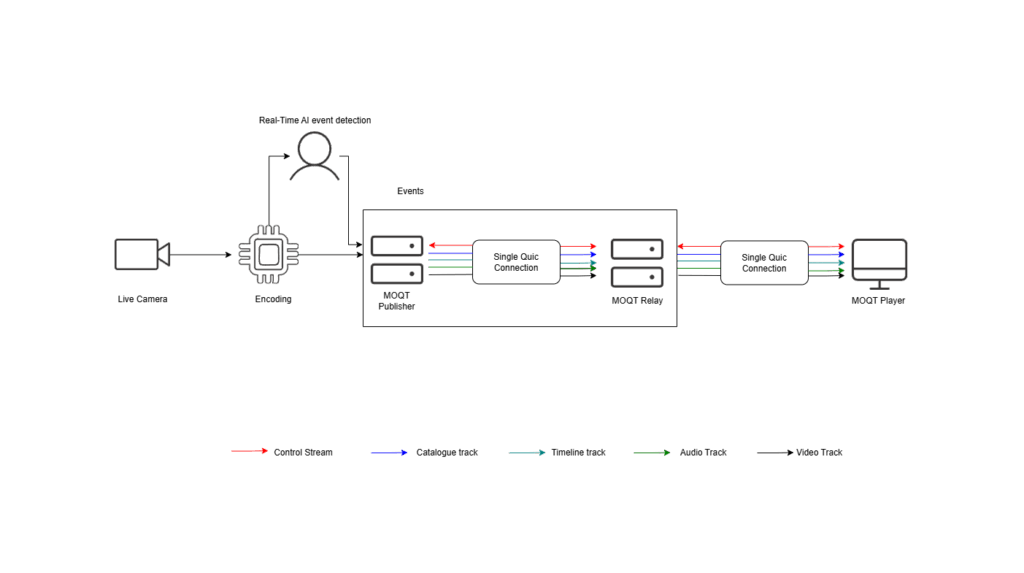
The future of surveillance is not more people staring at more screens. It is AI helping operators identify what matters. Organizations are increasingly using AI and vision-language models to detect accidents, identify traffic congestion, monitor critical infrastructure, detect wildfires, and surface other events that require immediate attention. Learn more about it from our previous blog “AI Detection Is Set to Transform Live Streaming“.
The faster video can move through the system, the faster those insights can be generated and acted upon. As AI becomes increasingly important for operational awareness, MOQ streaming for surveillance and monitoring can help deliver video data to analytics systems with minimal delay.
How Can You Try MOQ Streaming
Depending on your requirements for control and customization, you can take advantage of MOQ with either of our real-time streaming products:
1. Red5 Cloud (fully managed PaaS): in partnership with global CDN operator CacheFly, we’ve launched one of the first end-to-end production-ready MOQ streaming solutions that operates at global scale. Deploy real-time streaming without managing infrastructure, scaling, monitoring, or performance optimization. Join our limited beta.
2. Red5 Pro (self-hosted server software): The MOQ plugin integrates a full MoQ Transport relay server into Red5 Pro, adding QUIC-based streaming alongside the existing protocol stack. Deploy it on-premises, in closed networks and air-gapped environments, in public or private clouds, or in hybrid deployments. Use the CDN of your choice. Reach out to discuss your case.
Conclusion
MOQ streaming for surveillance and monitoring offers a practical path to lower latency, greater scalability, and more efficient video distribution. It also allows organizations to modernize their streaming workflows while continuing to use existing camera infrastructure and preparing for AI-driven operations.
As more organizations look for scalable ways to combine real-time video, AI analysis, and cross-agency collaboration, I think surveillance and monitoring are use cases worth watching closely. What do you think?

Chris Allen is the co-founder and CEO of Red5, with over 20 years of experience in video streaming software and real-time systems. A pioneer in the space, he co-led the team that reverse-engineered the RTMP protocol, launching the first open-source alternative to Adobe’s Flash Communication Server. Chris holds over a dozen patents and continues to innovate at the intersection of live video, interactivity, and edge computing. At Red5, he leads the development of TrueTime Solutions, enabling low-latency, synchronized video experiences for clients including NVIDIA, Verizon, and global tech platforms. His current work focuses on integrating AI and real-time streaming to power the next generation of intelligent video applications.