Table of Contents
One thing I’ve learned over the years building streaming infrastructure is that new video streaming protocols do not succeed just because they are technically better. They succeed when they solve real problems while still fitting into how the industry actually operates. That is part of why I’m excited to see our team becoming more involved with the Internet Engineering Task Force (IETF) and the ongoing MOQ (Media over QUIC) standardization work.
The IETF Draft About MPEG-2 Transport Stream Packaging for Media Over QUIC Transport
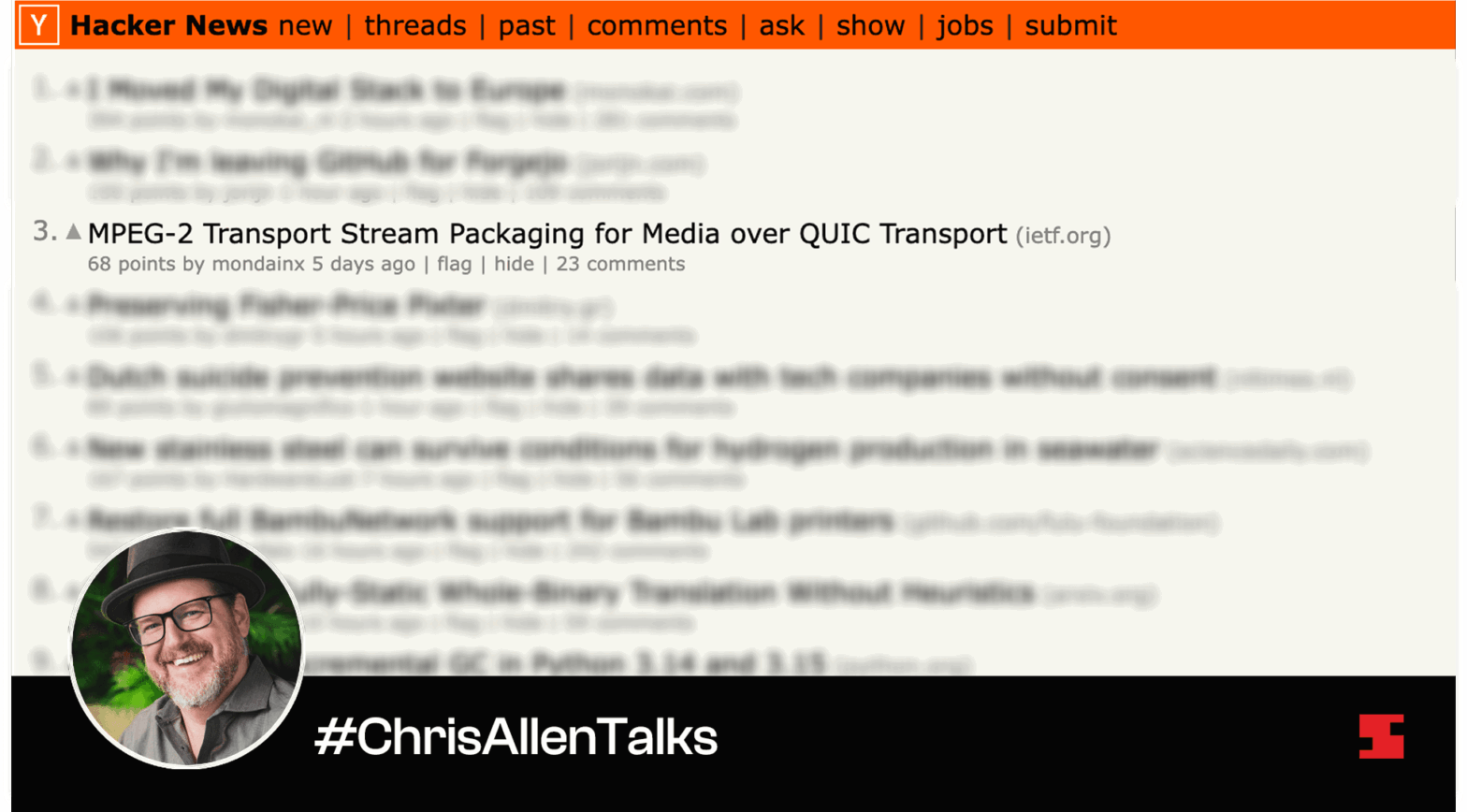
Last week, Paul Gregoire, our Solutions Architect, coauthored a new IETF draft together with Gwendal Simon, Senior Director for Video Network Technology at Synamedia, focused on MPEG-2 Transport Stream packaging for MOQ. The draft reached the front page of Hacker News within hours, but a lot of the discussion there misunderstood the value of this new draft.
At first glance, MPEG-2 TS might sound like old broadcast technology, but the reality is that an enormous amount of the world’s live video infrastructure still depends on it. Contribution feeds, broadcast workflows, satellite distribution, and many existing packaging pipelines all rely on transport streams in one form or another.
So while some people dismiss MPEG-2 TS as “old,” the reality is that huge parts of the streaming ecosystem still depend on it because it works reliably and is supported across a massive amount of infrastructure and hardware. In fact, it is used as the transport format in SRT, which according to Haivision’s 2026 Broadcast Transformation Report is by far the dominant ingest protocol in the broadcast industry today. And yes, I realize that you can technically use other protocols for the transport over SRT, but 99% of the usage today is MPEG-TS.
That does not mean newer or better approaches should not exist. They absolutely should. But if MOQ is going to succeed in real broadcast and contribution environments, compatibility with existing workflows matters a lot. This draft is not about excluding newer formats. It is about making sure MOQ can integrate cleanly into systems people are already running today. The draft also gets into practical deployment realities that people outside streaming engineering often do not think about enough:
- Random access points and stream joining behavior.
- Alternate bitrate track switching.
- Relay and subscriber processing.
- Multi-program transport stream handling.
- Timing, PCR continuity, and SCTE-35 signaling.
- Authorization and secure object delivery.
Conclusion
All of these details become more important as MOQ moves beyond experimental demos and into production broadcast environments, which I explained in my previous blog.

Chris Allen is the co-founder and CEO of Red5, with over 20 years of experience in video streaming software and real-time systems. A pioneer in the space, he co-led the team that reverse-engineered the RTMP protocol, launching the first open-source alternative to Adobe’s Flash Communication Server. Chris holds over a dozen patents and continues to innovate at the intersection of live video, interactivity, and edge computing. At Red5, he leads the development of TrueTime Solutions, enabling low-latency, synchronized video experiences for clients including NVIDIA, Verizon, and global tech platforms. His current work focuses on integrating AI and real-time streaming to power the next generation of intelligent video applications.