HLS Streaming Server
Build live streaming applications with live-to-VOD transitions, DVR playback, and time-shifted viewing powered by HLS streaming protocol.
TRUSTED BY







What is HLS Streaming?
HLS Streaming is an HTTP Live Streaming method that delivers live video with latency that varies from 5 to 30 seconds. Originally developed by Apple, it now works across browsers, smart TVs, set-top boxes, and game consoles. When viewers pause, rewind, or scrub back during a live stream, HLS naturally complements WebRTC by delivering that delayed content more efficiently.
Built for large-scale broadcasts, HLS created in Red5 Pro and Red5 Cloud can serve as a CDN origin with adaptive bitrate and broad device compatibility.

Deliver HLS Streaming with Red5
Live stream video, audio, and data using HLS protocol with wide device support, adaptive bitrate, and massive scalability through CDNs, with latency from 5 to 30 seconds to millions of viewers using Red5 Pro or Red5 Cloud.
Easy To Set Up and Use
Get started quickly with detailed documentation and step-by-step video tutorials that make setup and configuration simple.
Transparent and Flexible Pricing
Start streaming for free today with Red5 Cloud or Red5 Pro.
Hands-On Support
We reply to your support inquiries via email, through private dedicated channels in the Slack community for developers, and by phone.
Customers need sub-second latency that scales across many industries.
Live Auctions, Surveillance, Sports, Media, Online Gambling, Government, Interactive Shopping
Red5’s HLS Server Features

Live Streaming
Deliver video, audio, or data with 5 to 30 second latency across various devices, from smartphones to desktop browsers.

Autoscaling
Automatically scale from small deployments to global audiences based on demand.

Secure Streaming
Protect streams with AES-128/256 encryption.
Recording and VOD Capabilities
Record and store your live streams effortlessly for on-demand playback.
Compositing
Mix and arrange multiple video and audio feeds in real time using server-integrated mixers, choosing Brew for native performance or CEF for web-based flexibility.
Live Metadata Support
Send real-time metadata with your streams, including speaker names, song titles, scores, and captions, to power overlays, discovery, and interactive features.
Watermarking
Create a server-side watermarked stream to brand your content.
Server-Side Ad Insertion
Integrates with our patented SSAI technology for seamless monetization.
Analytics & Monitoring
Monitor your stream health, bitrate, frame rate, connection status, and latency with intuitive dashboards.
Closed Captioning
Enhance accessibility and engagement with real-time captions, ensuring your content reaches wider audiences anywhere, anytime.
Adaptive Bitrate
ABR adapts to network conditions and resends dropped packets for stable, high-quality audio and video even on congested networks.
Firewall-Friendly Connectivity
Simplify deployment with built-in NAT traversal and automatic handshake negotiation, enabling connections through most firewalls without manual configuration.
Multi-Browser Support
Deliver streams reliably across all major browsers using HTTP based playback, ensuring smooth viewing without plugins or specialized players.
Delayed Content Delivery
Enable live-to-VOD transitions, DVR playback, and time-shifted viewing so audiences can pause, rewind, and replay live content easily.
Consistent Delivery
Maintain smooth playback across shifting network conditions while reaching viewers reliably on any device or platform.
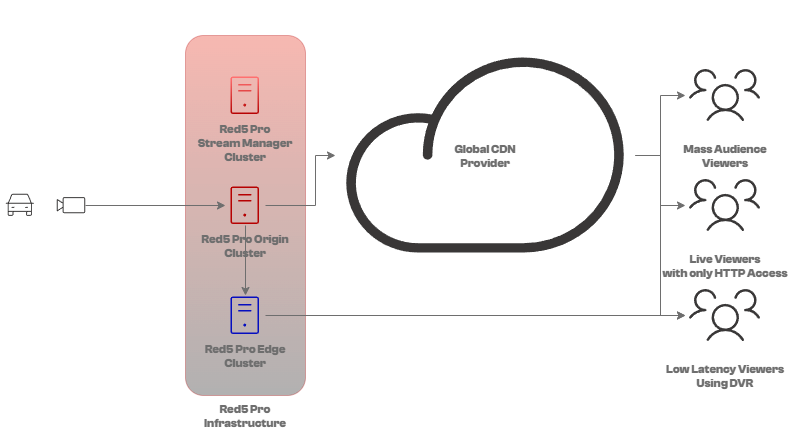
Diagram showing how HLS streaming works
FAQs
/
What is HLS?
HLS is an HTTP based streaming protocol used strictly for egress playback. It delivers segmented video to viewers across browsers, mobile devices, and smart TVs. Because it is designed for delivery only, you will rarely see HLS used for ingest. It is widely supported and reliable for large audiences.
/
What is HLS used for?
HLS delivers live and on demand streams at scale and is especially valuable when viewers move outside the real time window. When audiences pause, rewind, or scrub back during a live stream, HLS is the most reliable option for delayed or time shifted playback. It also powers large audience events like global broadcasts, live sports, concerts, conferences, education, faith programming, news, and long form entertainment.
/
What codecs does HLS support?
HLS supports common codecs such as H.264 (AVC) for video and AAC for audio. It can also deliver H.265 (HEVC), VP9, and AV1 and other formats as long as the playback device supports them. HLS remains flexible in accommodating widely adopted codecs without requiring changes to the core protocol.
/
What network environments work best with HLS streaming?
HLS works particularly well in environments with varying network conditions thanks to its HTTP-based delivery. Whether streaming on a high-speed broadband connection or a mobile network, HLS adjusts the quality based on bandwidth, ensuring reliable streams even in challenging environments.
/
Is HLS still relevant in 2025?
Yes. HLS remains highly relevant due to its widespread device support, CDN friendly architecture, adaptive bitrate playback, and reliable performance across networks. It continues to dominate large scale delivery where reach and stability matter more than real time interaction.
/
How to achieve low latency HLS?
Low latency with HLS is achieved using LL-HLS, an extension of the standard HLS protocol that reduces playback delay to only a few seconds. LL-HLS shortens segment duration and speeds up delivery, making it suitable for workflows that need lower latency without adopting a different streaming protocol.
/
How does HLS work?
HLS works by breaking live or recorded video into small media segments and delivering them over standard HTTP. A playlist file guides the player to fetch the correct segments at the correct quality. This approach allows scalable, stable playback across diverse devices and networks, especially when paired with a CDN.
/
How to stream with HLS for free?
You can start streaming with HLS right away using our fully managed, globally distributed streaming PaaS solution, Red5 Cloud. No credit card is required to sign up, and you’ll get 50 GB of streaming free each month. If you need more flexibility in deployment, you can also begin a 30-day free trial with Red5 Pro to explore custom setups.
/
Is HLS encrypted and secure?
Yes. HLS supports Transport Layer Security (TLS) to encrypt video segments as they travel across the internet. It also integrates with common Digital Rights Management systems, allowing publishers to control access and protect content from unauthorized viewing across devices and platforms.
/
How does HLS compare to other protocols?
HLS delivers video with standard latency that typically ranges from 5 to 30 seconds. Other protocols provide low latency around 3 to 10 seconds or ultra-low latency down to sub 250 milliseconds. Read our “WebRTC vs HLS” blog to learn how these two protocols compare in depth.
/
What kind of devices and browsers are compatible with HLS?
Thanks to its HTTP-based nature, HLS is compatible with nearly all modern devices and browsers. Whether it’s mobile phones, tablets, desktop computers, smart TVs, or other connected devices, you can be sure that your live stream will reach your audience seamlessly.
/
Can HLS be used together with other streaming protocols?
Yes. HLS often complements WebRTC and other ultra-low and low latency protocols in hybrid workflows. Real time streams can be delivered with WebRTC while delayed or time shifted playback uses HLS, especially when viewers pause, rewind, or scrub back during a live stream.
Start Streaming with HLS Today!
Not sure what solution would solve your streaming challenges best?
Watch our Youtube video explaining the difference between Red5 Pro and Red5 Cloud, check out the product comparison page, or reach out to us to discuss your case.