Table of Contents
MOQ hardware support is becoming one of the most important topics in the evolution of real-time streaming. While much of the industry’s attention has focused on software implementations, a growing number of companies are also beginning to explore how MOQ fits into hardware-based workflows. In this article, we’ll look at the current state of MOQ hardware support in 2026, the vendors already participating in the ecosystem, and the technologies helping accelerate adoption.
What MOQ Hardware Support Really Means
Much of the discussion around MOQ has centered around software development and what needs to be in place to support the ecosystem. However, hardware support is also an important part of the equation. If MOQ is going to become a widely adopted transport protocol, it needs to work across the devices that capture, process, distribute, and play back video.
This does not necessarily mean manufacturers will need to redesign core encoding or decoding hardware. In many cases, supporting MOQ may primarily involve software updates that enable MOQ-compliant transport and playback workflows. That distinction is important because it can significantly reduce the cost and complexity of adopting MOQ.
That said, there is still substantial work to be done around implementing and optimizing MOQ across hardware platforms. The discussion becomes even broader when considering IoT devices, drones, robots, and other embedded systems, which introduce their own unique requirements and opportunities.
Early Movers in the MOQ Hardware Ecosystem
Although the MOQ ecosystem is still in its early stages, several hardware vendors have already begun developing and testing MOQ-enabled products. For the purposes of this discussion, it’s useful to divide the landscape into two categories: encoders and playback devices.
Encoders
Hardware support is essential if we want MOQ to become the default standard for broadcast and eventually replace SRT delivery.
- We’re actively working with Osprey Video to enable live MOQ delivery, and testing compatibility with Red5’s MOQ relays and OpenMOQ’s MOQX implementations. More news on this coming soon.
- It is also great to see Ateme, another OpenMOQ Consortium member, already demonstrating MOQ support in its encoder. In the “Oracle Video @ Edge: Showcasing Media over QUIC Partner Workflows at NAB” blog, Oracle shared the OVE MoQ Partner Integrations diagram, which features the Ateme live encoder.
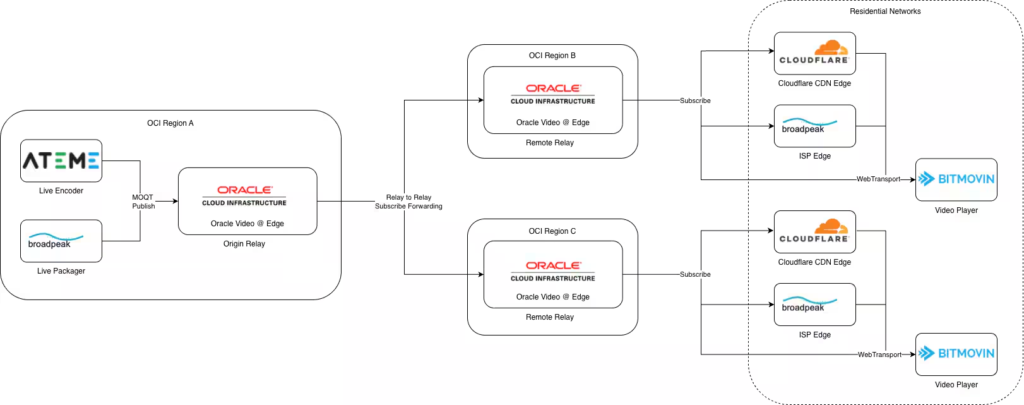
Source: https://blogs.oracle.com/cloud-infrastructure/oracle-video-edge-media-over-quic-workflows-nab
- We’re actively working with Videon to bring MOQ support to its encoders using the open-source MOQ5 library, which we’ll discuss in more detail later in this article.
As MOQ adoption expands, broadcast equipment vendors supporting standards such as ATSC 3.0 may also play an important role in bringing MOQ capabilities into traditional television workflows.
We are actively talking with other vendors, and this truly is just the beginning. I expect many more hardware vendors to step up, and this list is going to be huge by the time we discuss it again.
Players/Set-Top Boxes/Smart TVs
The player side has an equally important gap to fill.
- We’re actively working with Amino on a MOQ-based player for its platform, opening the door to set-top boxes, media players, operator deployments, and Smart TV experiences. Many of the use cases we’ve previously discussed around WebRTC can also be delivered with MOQ, but with improved scalability and costs due to the ability to leverage CDN infrastructure.
- Osprey Video also has Decoder devices, and we’re exploring opportunities to get MOQ playback working there as well.
- Smart TVs remain one of the biggest opportunities. WebRTC never achieved broad adoption across television platforms, and therefore, there still is no viable real-time delivery mechanism for these devices. I’d like to see the industry avoid repeating that mistake. What I’d really like to see next is for Smart TV vendors such as Google TV, Samsung, ROKU, and LG to become more involved. Fortunately, YouTube is a member of the OpenMOQ Consortium, so I’m hopeful that the YouTube/Google folks can help convince the Google TV people to help lead the way.
- Digital signage is another area where MOQ could have a significant impact. Beyond synchronized content delivery, it can support secure, real-time transactions such as digital signatures, identity verification, or ticket validation. Amino is one example, but I’d like to see more digital signage vendors embrace MOQ.
Native MOQ support across Smart TVs, set-top boxes, media players, and digital signage could dramatically expand where real-time streaming can be deployed. We’ve made great progress, but there’s still plenty of work ahead.
Open-Source Foundations for MOQ Hardware Support
On the software side, our team has developed MOQ5, an open-source C library with MOQ support for both ingest and egress. It provides an excellent foundation for implementing MOQ across a wide range of hardware platforms. You can learn more about this library in my latest blog post.
As part of the OpenMOQ Client Working Group, we’re actively building OBS, FFmpeg, and GStreamer implementations based on MOQ5. Those projects can then become the building blocks for hardware vendors looking to add native MOQ support.
MOQ5 also has bindings for Swift, and soon Kotlin, and Mobile devices on iOS and Android are two of the first target platforms. That said, I think mobile really belongs in its own category, and I probably should devote an entire post on that. So we will exclude it for today’s discussion.
We also see tremendous potential for robots, drones, and other embedded devices. I’ll probably also dedicate a future blog post to those use cases too.
Conclusion
MOQ hardware support is still in its early days, but the momentum is clearly building. Encoder manufacturers, player vendors, Smart TV platforms, and device makers all have an opportunity to help shape the future of real-time streaming while avoiding many of the adoption challenges that limited WebRTC’s reach outside the browser.
What excites me most is that we’re already seeing meaningful collaboration across the industry. OpenMOQ Consortium members, hardware vendors, CDN providers, and software developers are actively working together to make MOQ a practical reality.
As of July 2026, the list of companies exploring or implementing MOQ support remains relatively small, but it continues to grow. I’m particularly looking forward to seeing what emerges at IBC 2026 in Amsterdam this September. If the progress we’ve seen over the past year is any indication, the MOQ hardware ecosystem could look very different by the end of 2026.

Chris Allen is the co-founder and CEO of Red5, with over 20 years of experience in video streaming software and real-time systems. A pioneer in the space, he co-led the team that reverse-engineered the RTMP protocol, launching the first open-source alternative to Adobe’s Flash Communication Server. Chris holds over a dozen patents and continues to innovate at the intersection of live video, interactivity, and edge computing. At Red5, he leads the development of TrueTime Solutions, enabling low-latency, synchronized video experiences for clients including NVIDIA, Verizon, and global tech platforms. His current work focuses on integrating AI and real-time streaming to power the next generation of intelligent video applications.