Table of Contents
Today I want to discuss how the traditional divide between video calling and live streaming is rapidly disappearing. More teams are blending remote participants, live production, and broadcast workflows into a single seamless experience, and that shift is changing how interactive video is built and delivered.
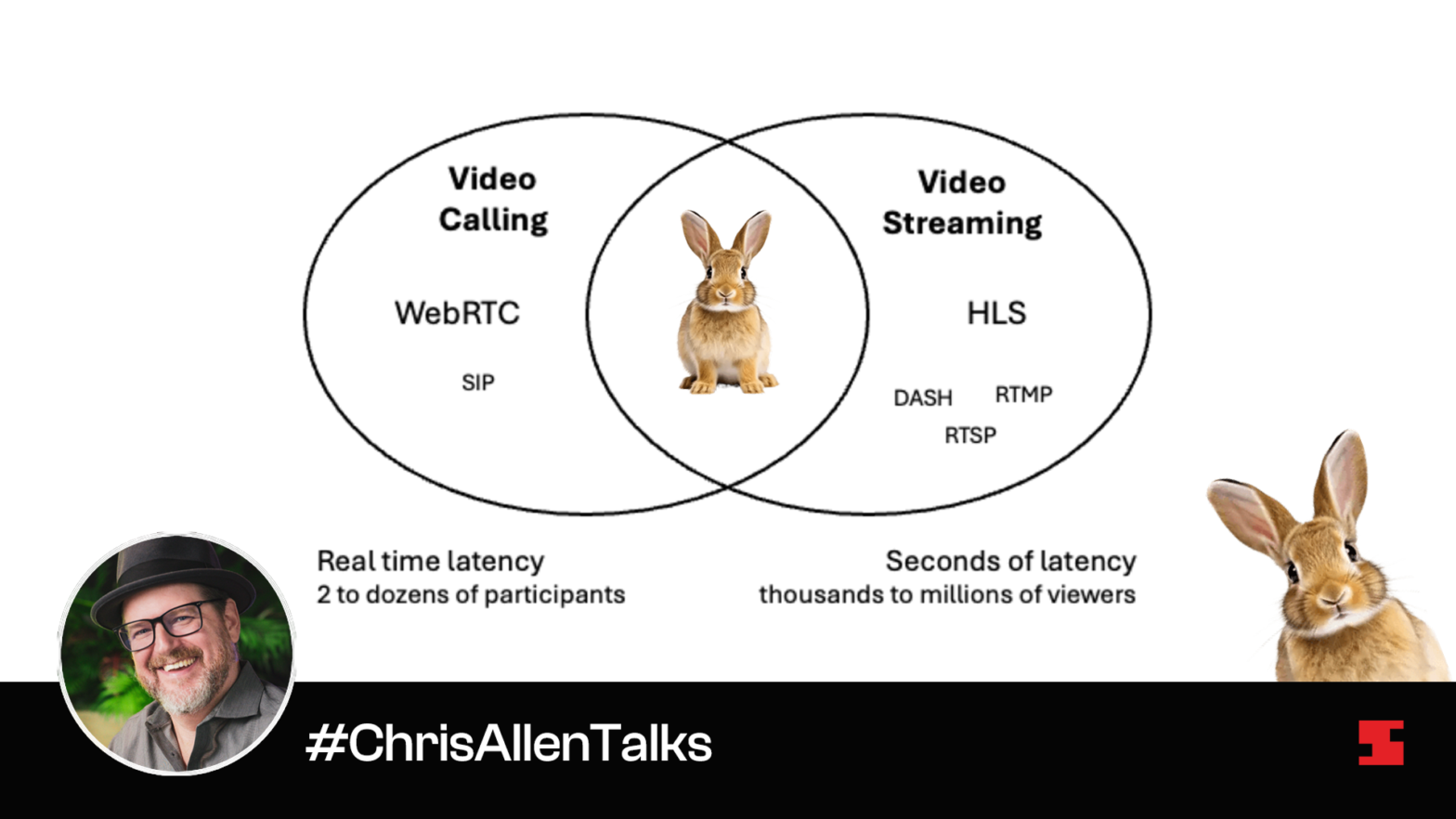
This blog was inspired by Chad Hart‘s Venn diagram from his WebRTC Hacks article, “WebRTC vs. MoQ by Use Case.” The diagram highlights the overlap between video calling and streaming. Maria Artamonova reused his diagram for the cover of this post and added a few bunnies, because sometimes we just need a little extra to grab attention on the Internet.
Watch my short talk on this topic on YouTube.
The Gap Between Video Calling and Live Streaming
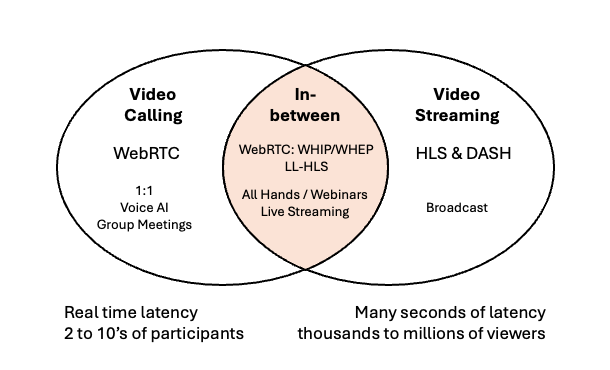
The gap between video calling and live streaming. Source: “WebRTC vs. MoQ by Use Case.”
For years, media on the internet evolved in two camps.
On the left: video calling. Real-time. Interactive. Many participants. WebRTC dominates. (What is WebRTC?)
On the right: streaming. One-to-many. Seconds of latency. HLS dominates. (What is HLS?)
And in between? A growing gap.
Meetings started getting larger. Hundreds, sometimes thousands of “attendees” who are really viewers. At the same time, streaming platforms like Twitch and others showed how powerful low-latency interaction could be. The lower the latency, the stronger the engagement. A 2025 study “VIBES: Exploring Viewer Spatial Interactions as Direct Input for Livestreamed Content” by Michael Yin and Robert Xiao at The University of British Columbia found that enabling near real-time interaction on Twitch under ultra-low latency conditions led to higher participation levels and increased viewer engagement compared to standard chat experiences.
In other words, scale wanted interactivity, and interactivity wanted scale. Both sides started pushing toward the middle. That middle is where things get interesting.
In-Between Video Calling and Video Streaming
When meetings and broadcast streams share the same real-time infrastructure, entirely new use cases emerge:
- Earnings calls where investors can ask live questions without a 15 to 30 second handoff.
- Sports broadcasts where remote fans join commentators seamlessly.
- In-stadium experiences where mobile views stay perfectly synced to the live action.
- Live commerce where viewers can speak directly to hosts without breaking the stream.
- Trivia, game shows, and interactive formats where the audience becomes the show.
- Watch parties that don’t feel like delayed second-screen hacks.
- Influencer-driven co-streams without awkward latency gaps.
- Hybrid events where “meeting participants” and “millions of viewers” are treated equally.
The benefit is not just lower latency. It’s architectural simplicity.
Historically, you had to switch protocols. Meetings were one system. Broadcast was another. When someone dialed in, you patched them in. When they left, you switched back. That transition created friction. If meetings and streaming are treated as the same real-time delivery model, that friction disappears.
This is why MOQ is interesting. It targets that middle ground. It challenges the idea that we need separate technologies for interactive calls and large-scale streaming. Cleaner architecture. One protocol. More flexibility.
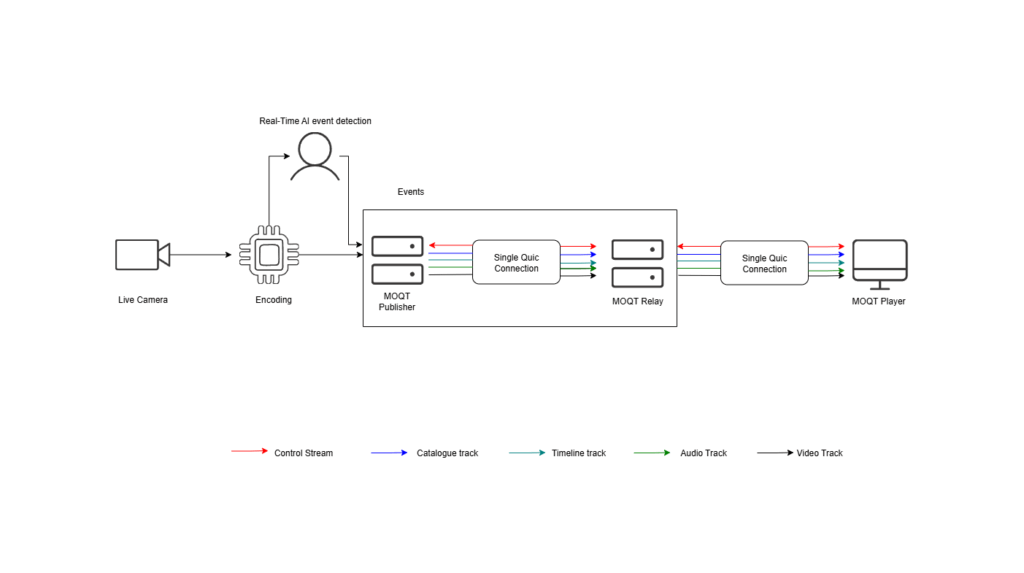
How MOQ Streaming Works.
Conclusion
Once that barrier between “meeting” and “broadcast” disappears, interactive video stops being split between two separate systems and becomes one unified experience. Video calling and streaming are converging toward a shared real-time architecture at the Speed of Thought that supports both large audiences and live participation. The result is simpler infrastructure, stronger engagement, and entirely new formats built around immediacy and scale.
Try Red5 For Free
🔥 Looking for a fully managed, globally distributed streaming PaaS solution? Start using Red5 Cloud today! No credit card required. Free 50 GB of streaming each month.
Looking for a server software designed for ultra-low latency streaming at scale? Start Red5 Pro 30-day trial today!
Not sure what solution would solve your streaming challenges best? Watch a short Youtube video explaining the difference between the two solutions, or reach out to our team to discuss your case.

Chris Allen is the co-founder and CEO of Red5, with over 20 years of experience in video streaming software and real-time systems. A pioneer in the space, he co-led the team that reverse-engineered the RTMP protocol, launching the first open-source alternative to Adobe’s Flash Communication Server. Chris holds over a dozen patents and continues to innovate at the intersection of live video, interactivity, and edge computing. At Red5, he leads the development of TrueTime Solutions, enabling low-latency, synchronized video experiences for clients including NVIDIA, Verizon, and global tech platforms. His current work focuses on integrating AI and real-time streaming to power the next generation of intelligent video applications.