Real-Time Data Streaming for Live Video: A Decision-Maker’s Guide to Interactive Streaming Infrastructure
Table of Contents
The pervasive infusion of interactivity into live video streaming across every corner of cyberspace has opened a new era in video commerce that leaves no room for impediments imposed by application-limited solutions.
Interactivity is now so entrenched wherever live streaming is in play, holistic support for all requirements related to any use of data in interactive user engagements should be woven into the fabric of every streaming platform hoping to compete for business with enterprises and institutions that rely on live video. That’s a long way from where things have stood in the runup to this transformative milestone in the evolution of online video.
What Is Real-Time Data Streaming In The Context Of Live Video?
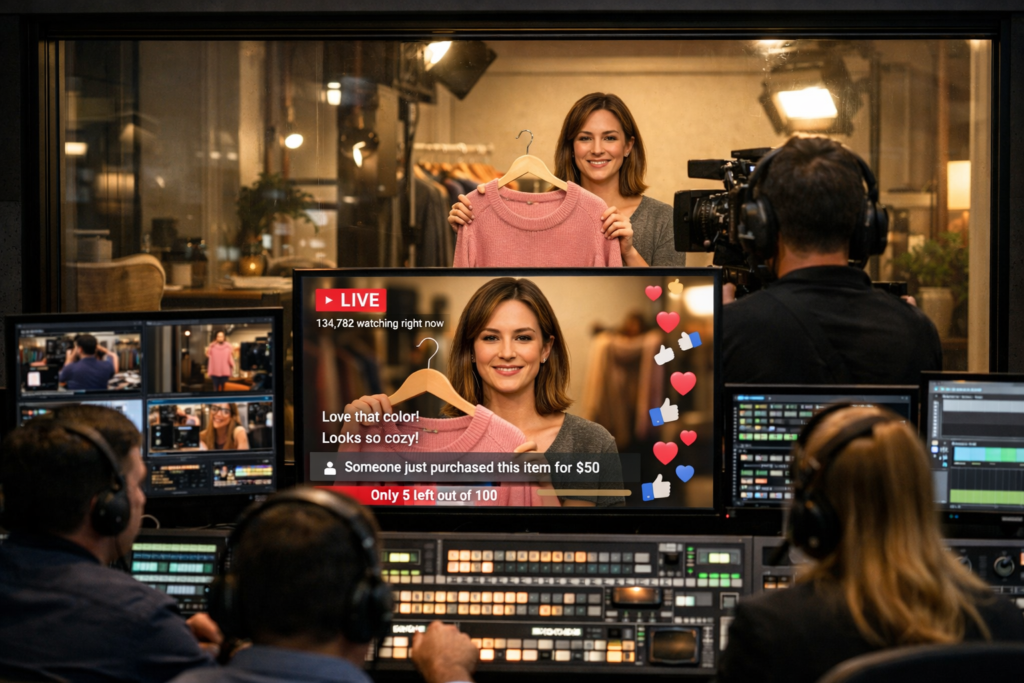
Live social shopping enabled by interactive real-time video and data streaming.
Real-time data streaming in the context of live video refers to the synchronized delivery of audiovisual streams and interactive data with end-to-end latencies low enough to enable immediate user response. It brings together multidirectional video and time-stamped data streams so that messaging, presence, analytics, AI processing, and application logic operate in precise alignment with what viewers are seeing in the stream.
Unlike one-way HTTP-based architectures where A/V and data components run on separate platforms that must be cobbled together, real-time data streaming integrates backend mechanisms essential to synchronized data and streaming functionality. This enables point-and-click activation of interactive features ranging from chat, polls, and collaborative engagement to AI-assisted analytics, multilingual captioning, real-time decision intelligence, and dynamic UI changes.
In practical terms, synchronized real-time video and data eliminate latency gaps, out-of-sync receptivity, and architectural limitations that constrain interactivity in traditional streaming environments. The result is a unified live-streaming framework capable of supporting immersive, scalable, and intelligence-driven experiences across education, commerce, sports, enterprise, and other domains.
How Real-Time Video and Data Sync Solves Business and Organizational Challenges
Use cases powered by interactive live streaming.
Across these scenarios, real-time video and data synchronization serves as a coordinated operational layer that addresses industry-specific challenges by ensuring video, data, user interactions, and control signals operate as a unified, precisely aligned system.
Live Shopping: Synchronized video, product overlays, pricing, and checkout flows ensure that offers appear exactly when they are presented, reducing cart abandonment and lost revenue caused by lag or disconnected commerce systems.
Watch Parties and Social Viewing: Shared reactions, synchronized playback, and real-time chat keep audiences aligned in the same live moment, preventing spoilers and fragmented engagement that weaken community growth.
Live Sports and Betting: Real-time stats, odds updates, and dynamic overlays remain aligned with live gameplay, protecting platform integrity, reducing regulatory risk, and preserving user trust.
Telehealth and Remote Care: Video consultations synchronized with clinical data and patient inputs support accurate decision-making and reduce the risks associated with delayed or mismatched information.
Online Auctions: Live bids, countdown timers, and results update in precise coordination with video feeds, preventing disputes, missed bids, and credibility issues.
Interactive Gaming and Collaboration: Player actions and shared tools respond instantly, maintaining competitive fairness and preventing lag that disrupts gameplay and teamwork.
Live Event Production: Multiple camera feeds, graphics, overlays, and interactive elements stay synchronized, reducing production errors and preserving broadcast quality.
Online Casino and Gambling Platforms: Live dealers, real-time odds, chat, and interactive interfaces operate in alignment, minimizing compliance exposure and improving player confidence.
News and Live Broadcasting: Breaking updates, graphics, and audience interaction remain synchronized with live footage, preventing outdated information and maintaining viewer trust.
Video Surveillance and Smart City Systems: Live video feeds coordinate with sensor telemetry and automated alerts, enabling faster response times in safety-critical environments.
Remote Robotics and Drone Operations: Live video streams synchronized with control commands and telemetry reduce operational risk where even small delays can cause physical damage or mission failure for military operations and public safety.
Industrial IoT and Manufacturing: Operators monitor video while controlling machines through real-time messaging, reducing downtime and improving workplace safety.
So far, most attempts to take the live streaming market where it wants to go miss the mark. In the case of providers like Agora, Stream, Amazon Interactive Video Services (IVS), Vonage and others that built platforms to enable interactive real-time video streaming among multiple users, their solutions were designed for the limited set of use cases that prevailed before the explosion to far more ubiquitous use of interactivity in live-streaming environments.
While these vendors developed compelling solutions for such low-volume use cases, they typically fall short when it comes to satisfying current needs. Critically, while such platforms generally support multidirectional video and data streaming at sub-500ms latencies, albeit at typically higher levels than the 250ms video and 100ms data latencies achieved by Red5 and PubNub, they don’t support the unlimited user scalability now essential to many use cases.
Moreover, to name just some of the other shortcomings, these platforms:
lack support for keeping pace with video quality tied to ever-rising display resolutions,
impose regional restrictions on deployments,
limit the range of protocols and stream volumes that can be ingested onto their platforms,
offer no support for monetization through dynamic server-side ad insertion (SSAI),
don’t enable use of digital rights management (DRM) for content protection,
and, to one degree or another, fail to take advantage of the latest advances in AI for things like text-to-speech conversion, real-time decision intelligence and analytics, and use of the Model Context Protocol (MCP) as a standardized approach to generating AI coding to improve things like context assessment, security and coding accuracy.
High-Growth Industry Demand for Interactive Live Streaming in 2026
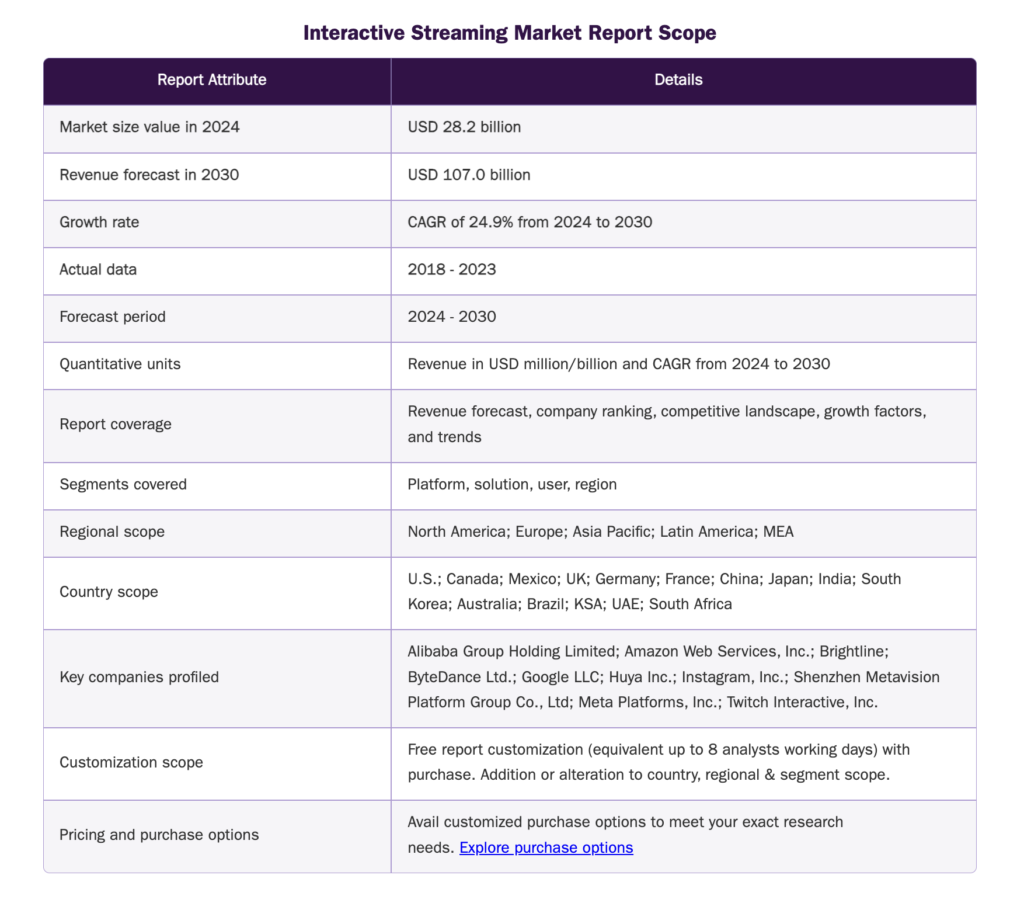
Source: Grand View Research, “Interactive Streaming Market (2024–2030)”
According to Grand View Research, the global interactive streaming market, encompassing every type of transactional and subscription use case involving textual or A/V interactivity in the enterprise and consumer markets, is growing at a 24.9% compound annual growth rate (CAGR) on course to expand from $28.2 billion in 2024 to $107.0 billion by 2030. Seen in the context of the live streaming market as a whole, which Value Market Research says hit $113.81 billion in 2024, the Grand View projections suggest the interactive streaming segment accounted for 24% of the total market in 2024 and will grow to 27% by 2030.
While much of the focus has been on consumer use cases such as live sports and betting, the surge of interactivity extends equally to live shopping, gaming, social networking, and enterprise environments including education, healthcare, and government. Education and e-commerce in particular illustrate how demand for synchronized data and live video is reshaping expectations for unified interactive streaming platforms.
The Surging Role of Online Interactivity in Education & Worker Training
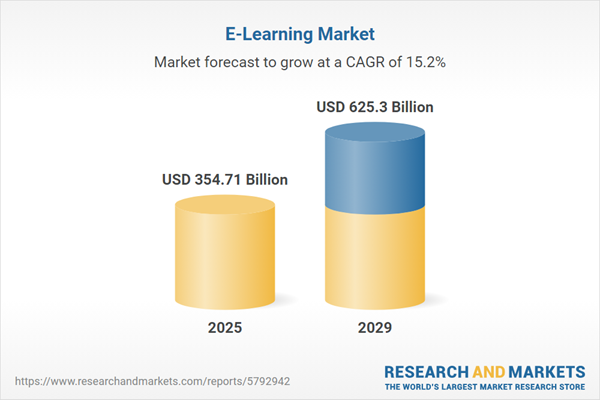
In the case of education, we’re now in a learn-anywhere era where live-streamed video connectivity is intrinsic to just about any learning program. As documented by Research and Markets, live-streamed sessions with support for interactive engagement of one kind or another are driving overall electronic-learning (e-learning) market growth at a 15.2% CAGR globally from $354.71 billion in 2025 to a projected $625.3 billion in 2029.
Source: Research and Markets, “E-Learning Market Report 2025”
Unlike unidirectional e-learning programs of the past, current approaches to remote learning, whether tied to educational institutions or corporate training initiatives, involve some form of real-time interactivity. Collaborative virtual classroom learning, virtual examinations, discussion boards and other approaches to student engagement are in wide use aided by artificial intelligence (AI), machine learning (ML), augmented and virtual reality (AR/VR), gamification and big data technology, the researcher reports.
According to another e-learning market report produced by researcher Technavio, which pegs the global market CAGR at 18.9%, higher education is the largest user segment with K-12 and corporate training close behind. In its latest report on e-learning, the National Center for Education Statistics said that, as of fall 2022, 54% of all college students were taking at least one course online and 26% were depending entirely on courses delivered online.
In the case of in-company education programs, the latest annual training industry report from Training Magazine says only 28% of total training hours are delivered in real classroom settings by instructors, with the remainder of the time split among e-learning modes, including 34% via stored software programs and 38% in various types of live interactive settings, including virtual classrooms, webcasting, and video broadcasting.
Statistics compiled by Research.com show that 88% of large enterprises, 84% of midsize companies and 70% of small businesses are relying to some degree on these live-streamed interactive training modes. AR and VR, too, are playing ever greater roles in the corporate domain, according to the Training Magazine report, which said large companies are the biggest users with 13% of such enterprises working with AR and 22% using VR.
Greater use of live streaming with support for interactive data input and socialized group learning experiences in e-learning in both the corporate and scholastic sectors has led to ever more sophistication in the learning programs, sometimes involving real-time video conferencing capabilities. It’s also increasingly essential for streaming platforms to be integrated with support for AI-assisted analytics, multilingual captioning and text-to-speech translations, adaptive learning programs and personalized information feeds. In the corporate domain, Training Magazine says AI usage rates in e-learning programs range from 17% among small companies to 25% and 46% among midsize and large enterprises, respectively.
Live Shopping Takes Hold in E-Commerce
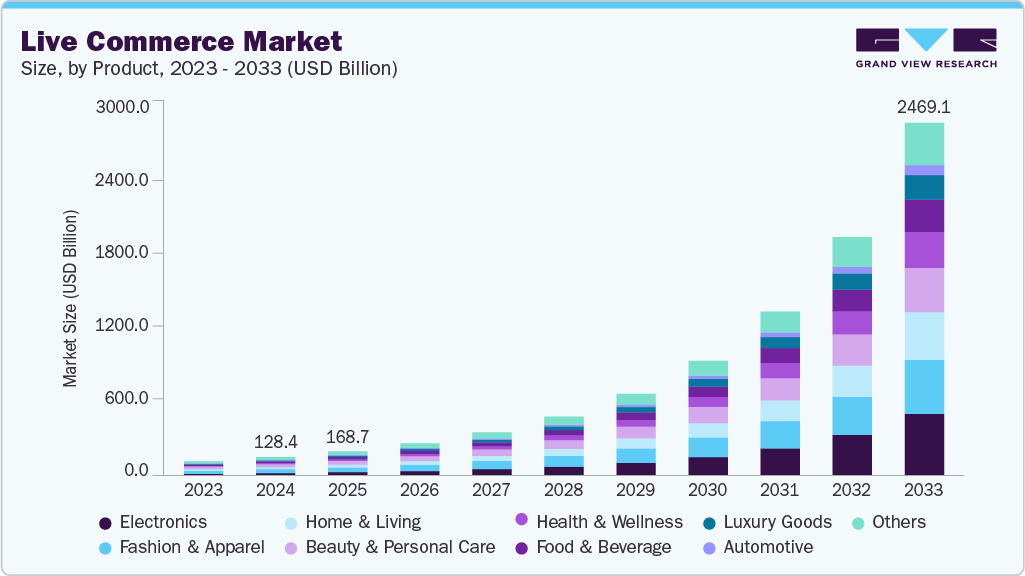
Source: Grand View Research, “Live Commerce Market (2025 – 2033)”
Meanwhile, the requirements imposed on live interactive streaming by the live-shopping component of e-commerce are no less rigorous than what’s demanded in the education/training arena. A report from Grand View Research estimates the live commerce market, which is defined as integrating live streaming with instant purchasing by consumers engaged with hosts or influencers, totaled $128.42 billion in 2024.
The researcher projects the market will grow at a 39.9% CAGR to reach $2.47 trillion by 2033.
While the Asia-Pacific region has been the dominant growth driver in live commerce with a 66% revenue share, Grand View says the U.S. is coming on strong with a projected 37.2% CAGR through 2033.
Live shopping is the natural outgrowth of growing consumer reliance on ecommerce as a complement or replacement to brick-and-mortar retail sales. At $6.56 trillion as of 2025, e-commerce represented 20.8% of all retail purchases worldwide, according to eMarketer.
Grand View says the biggest live-commerce product category is fashion and apparel with a 21.3% share of the market while the fastest growing segment is health and wellness driven by consumers’ pursuit of self-care solutions. According to a 2023 report from McKinsey, the average live-streamed shopping purchase amount per buyer on a per-show basis ranged between $82 and $90 in China to between $127 and $197 across the U.S., Europe and Latin America.
The growing strength of live shopping was underscored in late 2025 when The New York Times reported that Whatnot, a leader in the field, had secured $225 million in new investment funding. Whatnot is part of a wave of entities strictly devoted to live shopping like Pinterest, TalkShopLive, ShopShops, and NTWRK which, along with marketing established brands in multiple product categories, often enable individual consumers to sell pre-purchased and self-created items.
Leading social media sites like TikTok, Instagram, YouTube and Facebook are now supporting live shopping combining brand pitches with user-generated sales while individual brands and retailers, often with the help of third-party live-shopping toolsets, are bringing popular influencers and entertainment personalities into play on their sites, often mixing live pitches with interactions involving individual consumers. For example, online shopping giant Amazon now offers Amazon Live as a platform that creators and brands can use to support live interactions with shoppers.
Some marketers are even scheduling events featuring big-name personalities in social engagement with home viewers and in-venue attendees as a way to boost sales. According to McKinsey, shows featuring exclusive deals and promotions make up the most popular live-commerce content as attested by 64% of frequent users in Latin America, 56% in China, 47% in the U.S. and 41% in Europe.
Whatever the live shopping show format might be, viewers can view and click on links for products mentioned in the livestream, usually as a pop-up, sidebar, or pinned comment. Depending on the platform, they can either view and buy products within the interface itself or be taken to the brand’s website to complete the purchase.
Viewers can interact with the host or hosts via live chat to share thoughts about a product or ask questions that would help them buy the right product for their needs. When the shopping is supported by a real-time interactive streaming platform, socialization can also involve video communications between hosts and users.
Like corporate training, live commerce is proving to be another big driver behind the use of AR and VR, which adds to developments that should be taken into account by interactive live streaming platform providers. AR is now routinely used to place virtual 3D objects in live production sets for all viewers to see and to provide users who have AR eyewear an opportunity to visualize products in their own environments.
As for VR, the technology’s presence in the live shopping domain represents another instance where live-streamed connectivity plays an important role, in contrast to usage tied to game-playing and other locally stored software packages. Research conducted by SNS Insider pegged the global market for VR use in immersive shopping experiences at $3.3 billion as of 2023 with a projected 26.2 CAGR pointing to a $26.28-billion market valuation by 2032.
High areas of usage have to do with VR-equipped shoppers’ demand for 3600 product visualizations involving fashion, home décor and vehicles, SNS says. “E-commerce giants and brick-and-mortar stores are investing in VR to bridge the gap between online and in-store shopping, fueled by declining VR costs, growing internet penetration, and advancements in 5G networks,” the researcher explains.
The Interactivity Mandate in Live-Streamed Sports and Betting
The vast range of approaches to interactivity in education and e-commerce as described above is mirrored by requirements emerging with the marriage of interactive data and streaming wherever live video is in play. Notably, as reflected in our recent blog describing discussions at SVG Summit 2025 in New York, support for interactive data applications and social engagement in live-streamed sports and sports betting is now seen as table stakes as producers intensify efforts to keep fans engaged, especially when it comes to young audiences whose video consumption is less anchored in traditional sports than has been the case with previous generations.
The topic was a major theme at the National Association of Broadcasters’ event in New York in October 2025 as well. There, in one session devoted to the NFL, Paul Ballew, the league’s chief data and analytic officer, succinctly articulated what interacting with audiences entails for all sports bodies.
For us the goal is building out the means to see you, know you and act to give you the content that’s best for you. That involves intimacy that’s not overburdening but meaningful contact to focus on when you engage.”
– Paul Ballew, Chief Data and Analytics Officer at The National Football League
He acknowledged what a “heavy lift” it has been working with 32 different teams to create an efficient approach to interactivity that works for everyone. “It’s not about building a stack,” he said. “We think of it as an ecosystem involving technology, data, processing elements, regulatory elements. Capturing all those is the issue working with all 32 clubs’ approaches to content.”
Similar emphasis on interactivity is taking hold in other live-streamed content spaces occupied by major broadcast networks and local broadcast affiliates who are learning how to leverage the IP domain in ways that are beyond what they could do in traditional broadcast. This, too, was a focus at the New York NAB conference.
For example, Meredith McGinn, executive vice president of diginets and original production at NBCUniversal Local, noted how important support for social engagement has become in the free advertising-supported TV (FAST) space where live and stored programming is streamed on a scheduled linear basis. FAST has become a major revenue driver for broadcasters extending their ability to greatly expand programming to include local events and personalities who can’t be accommodated in the limited over-the-air channel space.
Our social reach is big. We’re training local journalists and working with content creators in the field to generate interactivity with viewers who are hungry for this kind of content. We’re always looking for opportunities to collaborate with people doing interesting things.””
– Meredith McGinn, Executive Vice President of Diginets and Original Production at NBCUniversal Local
The New Approach to Enabling Interactivity with Live Streaming
Architecting live streaming platforms to support modern interactivity requires fully integrated mechanisms that synchronize video and data while allowing users to activate interactive functions with point-and-click efficiency.
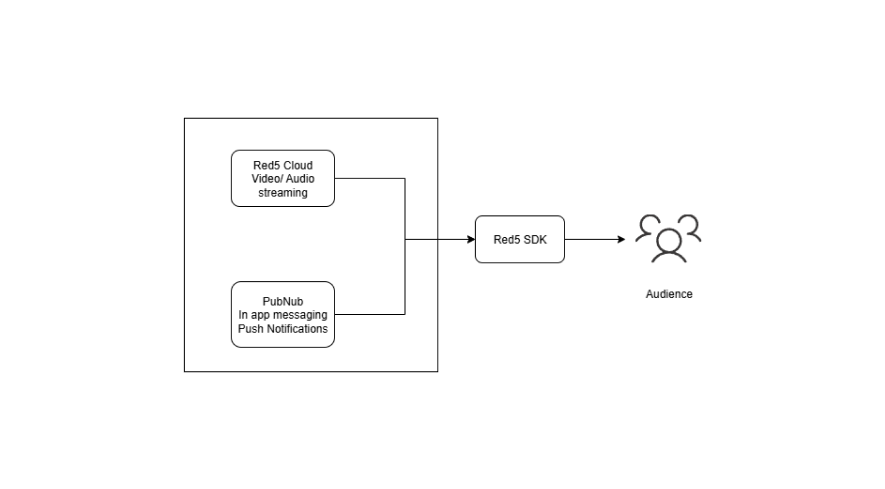
The seamless interoperability between the mechanisms controlling execution of operations on the PubNub data and Red5 Experience Delivery Network (XDN) infrastructures satisfies this requirement with unparalleled results in both domains. This integration enables time-stamped synchronization of A/V and data streams at sub-250ms video and sub-100ms data latencies worldwide.
Red5 Cloud-PubNub integration deployment diagram.
The elimination of operational complexity extends to every aspect of how the PubNub and Red5 platforms are designed. Critically, both platforms adhere to best-of-breed security practices with enforcement of TLS-only transport, API authentication and role-based access. And they comply with standards essential to viability in healthcare, finance and other enterprise-grade deployments, including specifications set by the Health Insurance Portability and Accountability Act (HIPAA), the EU’s General Data Protection Regulation (GDPR) and the Systems and Organization Controls 2 (SOC 2) data security framework.
This opens the door to unlimited possibilities in the application of interactivity with any live-streaming use case, including instances when customers employing Red5’s real-time XDN architecture want to revert to streaming A/V content over HLS. At the same time, customers are accorded maximum versatility in terms of how they choose to put their combined capabilities to use, either as a fully managed solution through reliance on the Red5 Cloud service or in self-managed implementations with utilization of the Red5 Pro and PubNub suites of SDKs and APIs.
The PubNub Platform
The PubNub logo.
Looking first at the data fabric supported by PubNub, the platform enables edge-accelerated interactivity aided by AI over a global DSN spanning 15+ regional points of presence. With fail-safe redundancy and peak traffic elasticity enabling five 9s SLA performance scaling to millions of users, PubNub has built a global customer base generating trillions of messages monthly across multiple industry sectors, including live sports, esports and other M&E services, online betting and casino gambling, video games, ecommerce, and other sectors such as health and transportation.
With built-in automated use of generative AI, the PubNub Illuminate digital intelligence suite goes beyond traditional interactive data applications to create an app-development framework customers can employ however they like to optimize real-time user experience, deliver insights into usage behavior, fine-tune applications on the fly, push notifications, support IoT device control and much else. Notably, customers can:
Automatically enhance chat at massive scales with text-to-speech, real-time multilingual translations and the ability to interact with users naturally,
Store and access user or app metadata in a flexible, always-available data layer,
Share large image, video and other stored document files between users and/or devices in real-time,
Track user and device activity in real-time with instant awareness of who’s online, offline or active in a specific channel,
Access a full suite of tools that leverage the monitoring insights to configure and moderate users, channels and interactions utilizing custom logic to process, route, filter or transform messages as they move through the network,
This is a developer-friendly environment that minimizes the need to write code, allowing product and operations teams to experiment rapidly, automate responses, and continuously iterate through an intuitive point-and-click interface. Utilizing Illuminate’s no-code decision tables, customers can define adaptive rules and automate reactions to real-time conditions with dynamic UI changes, personalization logic, workflow moderations, and in-session features. And when there’s a need for new coding, customers can employ the Model Context Protocol to connect any of PubNub’s 50+ SDKs to AI assistants for code generation, testing, and debugging real-time features.
The Versatile Support for Interactivity Embodied in Red5’s XDN Architecture
Red5’s XDN Architecture is ideally suited to bring all these capabilities into play in any live-streaming scenario with the underlying support for streaming in real-time that’s essential to the lion’s share of next-gen interactive use cases.
Here we summarize some of the key highlights, starting with the previously mentioned approaches to activating the PubNub-enhanced Red5 interactive live streaming solution either as a natively integrated component of the fully managed Red5 Cloud service or with DIY implementations through the Red5 Pro DevOps framework. Critically, whatever approach is taken customers benefit from the unlimited scalability that’s intrinsic to all Red5 and PubNub platform implementations.
The highly automated Red5 Cloud PaaS activates real-time streaming infrastructure using global Oracle Cloud Infrastructure (OCI) resources dedicated exclusively to each customer’s needs in response to dashboard inputs setting geographical reach, targeted user counts and other basic parameters. The service includes sustained managed support for maintenance, changes in original parameters and other needs through the entire engagement life cycle.
Red5 Cloud integrated with the PubNub Platform provides real-time APIs for messaging, presence, and interactive features, plus embedded no-code decision intelligence for continuous optimization. API-first provisioning in conjunction with PubNub SDKs and AI-assisted development serves to accelerate innovation cycles with maximum cost efficiency supported by transparent, usage-based billing that avoids per-minute streaming charges, hidden overages and forced bundle pricing. The integrated solution is OEM-ready, allowing Red5 to offer it under its own brand and give customers the ability to integrate it into their own platforms.
Customers choosing to pursue the Red5 Pro DevOps approach can mount XDN infrastructure in public or private clouds utilizing a comprehensive portfolio of Red5 Pro SDKs and open APIs with recourse to assistance from Red5 personnel. Public cloud XDN infrastructures built with Red5 Pro can operate seamlessly with no loss of latency in cross-cloud scenarios involving the leading cloud providers, including AWS, Google Cloud, Microsoft Azure, OCI and others that have been pre-integrated with the platform, as well as many more that can be integrated for XDN use with the aid of the Terraform open-source multi-cloud toolset.
With either approach the fundamentals pertaining to how public or private cloud resources dedicated to Red5 operations are structured and orchestrated are the same. This encompasses all the capabilities enabled by the widely employed TrueTime Solutions such as MultiView, WatchParty, Studio and DataSync, the brand new massively scalable TrueTime Meetings stack supporting next-gen video conferencing, and the extensive set of SDKs, APIs and integrations with partner solutions.
In all cases XDN infrastructures run on commodity servers in locations that can be hierarchically configured to seamlessly operate in cloud clusters as Origin, Relay and Edge Nodes under management orchestrated by the XDN Stream Manager. One or more Origin Nodes in a cluster serve to ingest and stream encoded content out to Relay Nodes, each of which serves an array of Edge Nodes that deliver live unicast streams to end points in their assigned service areas. In cases encompassing a small geographic area or very few end points, content is streamed directly to Edge Nodes without the use of Relay Nodes.
The node management and routing capabilities of the XDN architecture enable configuration of servers within any given node location to provide real-time streaming support for content in all directions. For example, servers in any datacenter housing an Edge Node can also serve as host to an Origin Node for ingesting content from proximate users with routing executed from there across the most direct node paths to other users. Or any Origin Node location can also be put into service as host to an Edge Node.
Origin node placements can be optimized to accommodate ingestion of massive volumes of streams delivered from H.264, H.265, VP8 or VP9 encoders at resolutions all the way to 4K. Incoming streams can be formatted to any of the leading contribution protocols, including RSTP, RTMP, ERTMP, SRT, Zixi Software-Defined Video Protocol (SVDP), MPEG Transport Stream (MPEG-TS), and HLS, as well as WebRTC and its simplified version WHIP and WHEP, which is the primary transport mode currently used for distribution over XDNs.
In addition to WebRTC on the distribution side, the flexible protocol-agnostic XDN Architecture supports use of RTSP to reach mobile devices in real-time, and it leverages the Real-time Transport Protocol (RTP) underlying WebRTC and RTSP to enable packaging of ingested RTMP, MPEG-TS and SRT encapsulations for XDN transport when devices compatible with these protocols can’t be reached via WebRTC or RTSP.
Adding to the versatility, XDN Architecture is now supporting the emerging IETF MOQ Transport (MOQT) standard in alliance with global CDN operator CacheFly to provide customers an opportunity to begin working with the protocol ahead of anticipated standard finalization this year. This ensures that as real-time streaming over MOQ gains ascendancy, MOQ-over-XDN infrastructures will be able to immediately initiate live interactive streaming strategies utilizing the PubNub enhancements.
Meanwhile, as real-time streaming gathers ever more momentum, the existing HTTP-based streaming infrastructure is alive with live-streamed use cases where data-based interactivity solutions are exploding across the internet. Here, too, the benefits of the fully integrated Red5 and PubNub platforms can be brought into play thanks to the support XDN Architecture provides for seamless switchover from real-time distribution to reliance on HLS. Recourse to combined Red5 and PubNub support over HLS streams joins other HLS options available in the XDN domain, including support for user-induced trick plays, live-stream recording for catch-up features, network DVR or other approaches to recording live content for VOD playback, and stream handoffs when devices are unable to support WebRTC or other protocols encapsulated for RTP transport.
The Red5 live A/V streaming contribution to interactivity adds other essential components that must be brought to the table with the data capabilities of PubNub. This includes support for monetization through server-side ad insertions (SSAI) in video streams flowing in any direction and enhanced content protection that adds use of forensic watermarking to the multi-DRM and native WebRTC security supported by XDN Architecture.
Real-time video and data synchronization now make it possible to integrate socialized interactivity across e-commerce, media, entertainment, and enterprise environments with point-and-click efficiency. With AI-driven analytics, event-synced data, and conversational responsiveness operating in alignment with live streams, interactive experiences can be deployed over both real-time and conventional streaming workflows. The transition to real-time interactive streaming via WebRTC or MOQ on XDN infrastructures reflects the direction live streaming is headed.
Try Red5 For Free
🔥 Looking for a fully managed, globally distributed streaming PaaS solution?Start using Red5 Cloud today! No credit card required. Free 50 GB of streaming each month.
Looking for a server software designed for ultra-low latency streaming at scale?Start Red5 Pro 30-day trial today!
Not sure what solution would solve your streaming challenges best? Watch a short Youtube video explaining the difference between the two solutions, orreach out to our team to discuss your case.
The Red5 Team brings together software, DevOps, and quality assurance engineers, project managers, support experts, sales managers, and marketers with deep experience in live video, audio, and data streaming. Since 2005, the team has built solutions used by startups, global enterprises, and developers worldwide to power interactive real-time experiences. Beyond core streaming technology, the Red5 Team shares insights on industry trends, best practices, and product updates to help organizations innovate and scale with confidence.
By Red5 Team
The Red5 Team brings together software, DevOps, and quality assurance engineers, project managers, support experts, sales managers, and marketers with deep experience in live video, audio, and data streaming. Since 2005, the team has built solutions used by startups, global enterprises, and developers worldwide to power interactive real-time experiences. Beyond core streaming technology, the Red5 Team shares insights on industry trends, best practices, and product updates to help organizations innovate and scale with confidence.