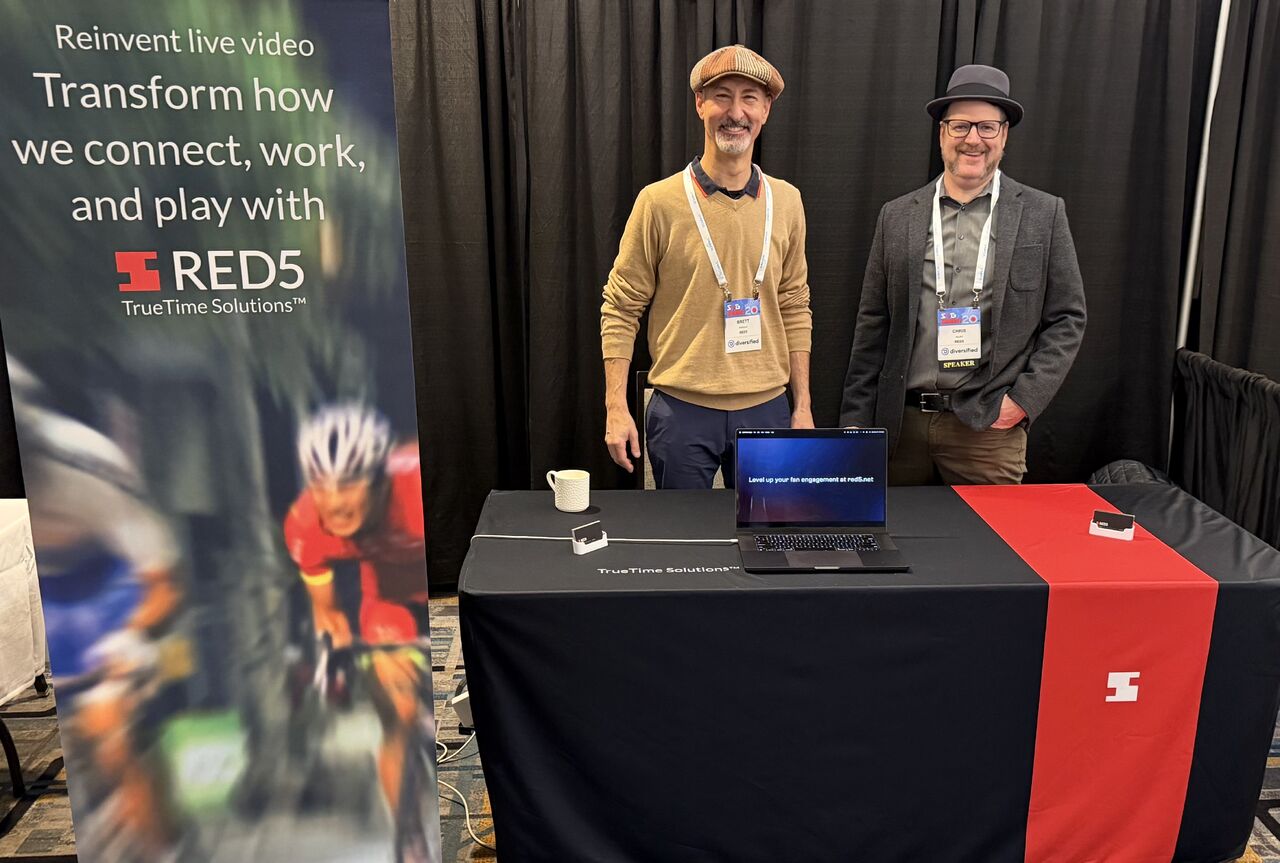
SVG Summit 2025 brought together live sports production leaders to discuss how mounting workloads, evolving fan expectations, and rapid technology shifts are reshaping the future of sports media. From broadcasters and platforms to technology providers, the conversations highlighted a growing urgency to move beyond traditional one-way streaming toward more scalable, real-time, and interactive production models.… Continue reading SVG Summit 2025: Live Sports at a Breaking Point and the Technologies Reshaping What Comes Next
SVG Summit 2025 brought together live sports production leaders to discuss how mounting workloads, evolving fan expectations, and rapid technology shifts are reshaping the future of sports media. From broadcasters and platforms to technology providers, the conversations highlighted a growing urgency to move beyond traditional one-way streaming toward more scalable, real-time, and interactive production models.
In this blog you will learn how industry leaders are addressing production overload, why real-time streaming is becoming inevitable, how personalization and interactivity are redefining fan engagement, what role emerging standards like MOQ play in the future of live sports, and how AI, cloud-based workflows, and immersive experiences are shaping the next phase of sports production.
Table of Contents
About SVG Summit 2025

The 20th SVG Summit, held in December 2025.
The year-end perspective on live sports production conveyed by industry leaders at the Sports Video Group Summit in New York City cast a bright light on the transformative role Red5 can play in helping them reach next-gen goals despite unprecedented surges in workloads. Watch the live stream of this event here.
The atmosphere at the Summit was vibrant with anticipation of what lies ahead. As Fox Sports EVP for technical and field operations Mike Davies put it during one panel discussion, “What’s really awesome about this business is we’re in a dream it, do it era. There’s nothing that technology can’t solve.”
But he noted the time drain on staff resources is so intense it’s creating risks to keeping up with the expanding workflows, let alone finding time to explore new ideas. “When does something not get done?” Davies asked. “I don’t think it’s going to be in 2026, but at some point, that’s going to be the case. That’s the fear, and I think everybody on this stage is living that to a certain extent.”
The conundrum was summarized by the panel’s moderator, SVG board member and head of production at NEP Group Jeff Jacobs. “Here’s the problem with innovating,” Jacobs said. “Everyone is so busy producing so many events, there’s no time.” Under these conditions, he added, “it’s tough to get creative people’s attention to chip in.”
Partnerships & Developments Underscore the Inevitability of Real-Time Streaming
But as Red5 CEO Chris Allen made clear during the Summit panel devoted to exploring what user experience (UX) will look like in 2026, much of what’s needed to accelerate transformation, including a real-time interactive streaming platform with unlimited scalability, can be implemented without going through lengthy ramp-ups.
A timely new validation of Allen’s message was delivered at the outset of the SVG Summit by AWS, which accorded Red5 top-tier recognition as a Media & Entertainment Competency Partner. This confirms Red5 has met rigorous AWS best-practice standards related to technical excellence, measurable customer outcomes and architectures.
Red5 Achieved AWS Media & Entertainment Competency.
In other words, the capabilities described by Allen at the SVG Summit refute the misinformation, as debunked here, that has forestalled wider adoption of platforms exceeding what can be done in the prevailing one-way high-latency streaming domain. Allen acknowledged how hard it’s been to overcome this mythology, notwithstanding Red5’s success at deploying its Experience Delivery Network (XDN) Architecture to enable advanced execution of the WebRTC protocol in support of highly scalable real-time interactive streaming.
But Allen also made it clear that, whether live sports producers embrace real-time streaming now or later, its inevitability is assured with emergence of the IETF’s MOQ standard, which is slated for completion in the near future. “I’m really excited about MOQ,” he said, noting that standardization of a scalable real-time streaming solution will ensure everyone gets the message that the tide has shifted.
Red5 as a member of the OpenMOQ Software Consortium is committed to supporting MOQ, which, with the cloud resource orchestration enabled by XDN Architecture, can be counted on to meet the performance goals Red5 has set with WebRTC. Allen revealed Red5 will soon be releasing an end-to-end MOQ product in partnership with the global CDN operator CacheFly.
Red5 Joined the OpenMOQ Software Consortium.
The SVG Summit also gave Allen and global sales SVP Brett Fasullo the opportunity to make new connections in the sports industry, including leaders from the expanding realm of Tier 2 and 3 sports. And they found time to discuss new initiatives with AWS and another key partner, PubNub.
Having reached the competency partner milestone following many others over the course of the long AWS-Red5 partnership, Red5 has begun working with AWS officials to plan new Software-as-a-Service (SaaS) products for introduction through the AWS Marketplace early in 2026. The initiative promises significant enhancements to what can be done with streaming architecture implemented on AWS cloud resources.
With PubNub the focus was on working with VP of business & corporate development Jonas Gray to let attendees know about the companies’ jointly developed interactive data and video platform. Red5 will soon be saying more about how Red5’s global real-time interactive XDN streaming infrastructure in combination with PubNub’s global data app communications network and AI-assisted discovery provides the comprehensive interactive streaming solution sports producers are looking for.

Jonas Gray, Chris Allen, Michael Chauner, Branko Lepan, and Brett Fasullo at SVG Summit 2025.
Executive Discussion Links XDN to Multiple Sports Production Goals
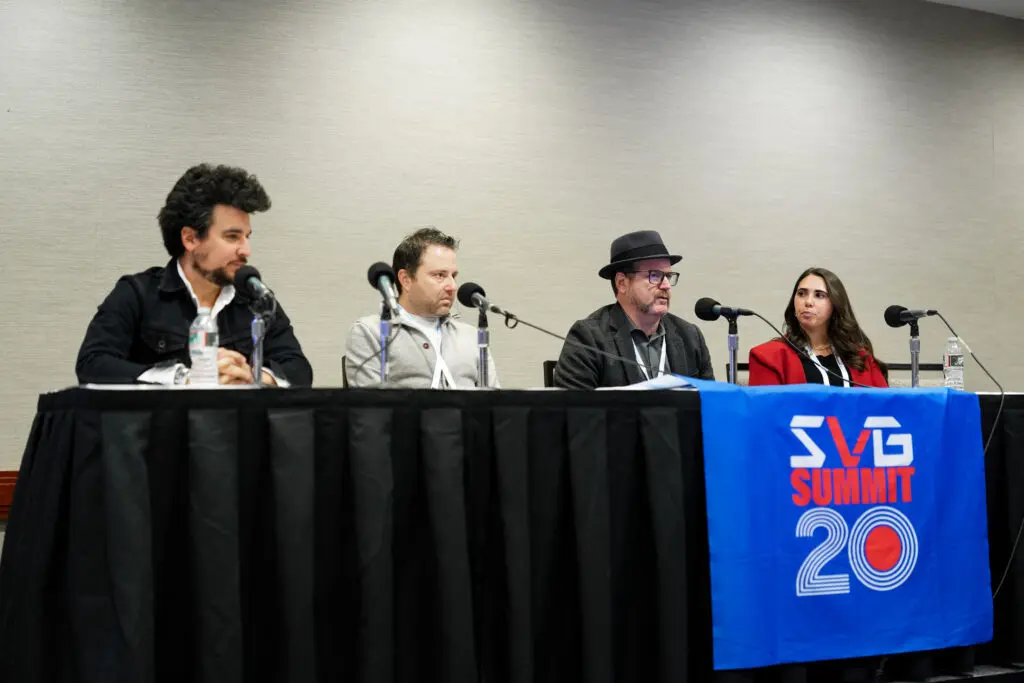
Chris Allen at the “User Experience 2026: Interactivity, Personalization, and Monetization in the New DTC World” panel at SVG Summit 2025.
During Allen’s Summit panel appearance, integrated data and video interactivity was one of the many applications under discussion that can be implemented with Red5’s TrueTime toolsets on XDN infrastructure through either the Red5 Cloud SaaS platform or with self-managed cloud iterations enabled by Red5 SDKs. These address both the front-end UX and backend production aspects of the live sports production challenges.
The need for such solutions was common to multiple use cases that the other panelists said are engaging their full-time attention. The illustrious group included Ricardo Perez-Selsky, senior director for digital production at Fox Sports, Michael Scheider, COO and GM for DTC operations at FanDuel Sports Network, and Char Zoller, partner engagement manager for live sports at YouTube.
For example, Char Zoller, noting the role online influencers can play in driving fan engagement, mentioned how important this was for drawing Brazilian viewers to YouTube’s first live streamed NFL game, which took place September 5 in Sao Palo between the Kansas City Chiefs and Los Angeles Chargers. Amplifying on the concept, Chris Allen shared the fact that Red5’s support for real-time connectivity of dispersed influencers in live-streamed soccer games has been central to the company’s operations in Brazil and elsewhere in Latin America following its acquisition of Dale, the Brazilian startup that, with Red5’s help, brought such capabilities to life in the region.
Today, the Red5 Latin America team is leveraging the remote production capabilities with “a whole studio in the cloud,” Allen said. In fact, he added, instances of this use case have involved contributions to live stream distribution through YouTube.
As described at length in this blog, bringing in influencers as fan-favored alternatives to broadcast commentators is just one of the major benefits accruing to producers when Red5’s real-time Experience Delivery Network (XDN) Architecture is used to simultaneously link remote participants in real-time production workflows. Other benefits include reductions in the need for on-site production staff and gear and the ability to perform editing and selection of any screen rendering from multiple streams consolidated for simultaneous viewing in the workflow.
Much of the UX panel discussion focused on the front end of the live-streamed sports flow, where both localized and individually personalized enhancements to UX are essential to building fan engagement. This is table stakes in an environment marked by short attention spans saturated with input from every corner of the global web.
The Ambitious Fox One Agenda
What the shift to live sports streaming means to broadcasters is well illustrated by the DTC Fox One service Fox launched in 2025, which, as Perez-Delsky put it, allows the broadcaster to shape “content to drive users across social media and different channels to meet fans where they are.”
He cited several examples of how Fox is doing this beyond maintaining a multi-outlet presence, including creation of short-form content that can be used across social media and other outlets to speak in ways that appeal to users about what’s going on in the sport.
As Allen noted, identifying and analyzing video segments to compile three-minute clips relevant to any given group can be greatly aided by AI, especially when production can be executed with the ability to instantly extract any frame from any video flow for immediate AI-assisted analysis.
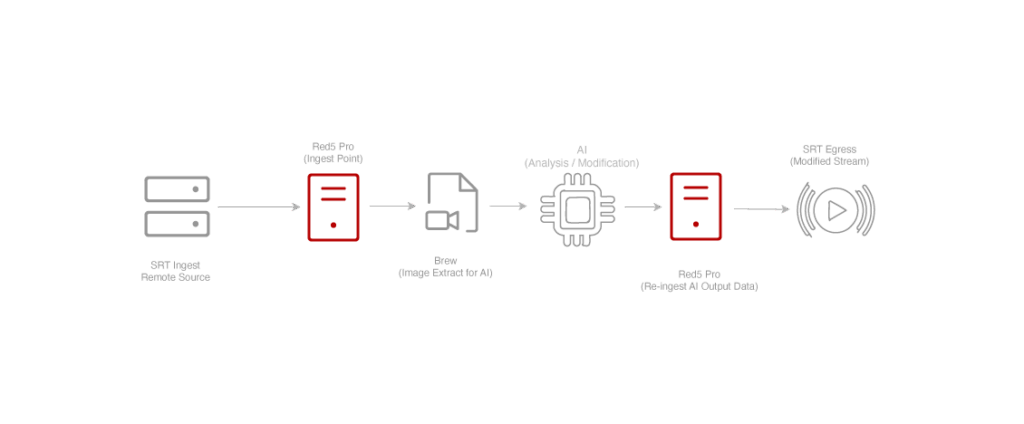
Diagram illustrating real-time frame extraction and encoding for AI in live streaming using SRT.
Allen revealed Red5’s live-frame extraction process, which, as described here, marks a first in live video streaming, will be a key component in new approaches to using AI Video Language Models (VLMs) that Red5 will be introducing in the year ahead.
Such capabilities will also play a big role in adding video to ancillary data flows dedicated to personalizing each user’s experience, Allen noted. With these new VLM-enabled enhancements, it will be possible to generate content that otherwise would be cost prohibitive, he said, adding, “AI will be a big game changer.”
This applies to the types of immersive viewing experience used with virtual reality (VR) and augmented reality (AR) technology that Ricardo Perez-Selsky noted Fox Sports is exploring with the pioneering “shared-reality” venture Cosm. That firm is delivering shared immersive viewing experiences from 1800 cameras positioned around playing fields to audiences seated in massive 12K LED domes currently operating in Dallas and Los Angeles.
Along with working with Cosm to deliver immersive viewing of Fox-produced NFL games to dome-based audiences without the use of headsets, Perez-Selsky said the partnership enables Fox Sports to use the Cosm field cameras to feed highly personalized immersive experiences to viewers equipped with VR headgear. “When personalization is set up in immersive environments, it unlocks more ways to consume content,” he said. “For the viewing experience to be 100% customizable, it needs to be immersive.”
Such capabilities will be reaching much larger audiences when headset form factors are reduced to the dimensions now seen with AR glasses, Allen noted. Moreover, with simultaneous real-time connectivity enabled by the XDN platform, such immersive viewing can be made part of a shared interactive social experience.
Personalization of what’s delivered to users based on where they are or what they’re drawn to is a big part of agendas described by everyone on the panel. In FanDuel’s case, as with Fox Sports, this involves adding short-form content that can draw people beyond the core base of fans already attuned to betting. Scheider said his team is creating content appealing to user’s interests that’s not directly related to a game and betting, including “pulling in local content.”
Socialization & Other UX Goals
FanDuel is also focused on enabling “sports betting in the stream” and “bringing people together” in shared betting experiences, Scheider noted. In-stream betting gets away from relying on second-screen streams to enable betting-related odds and other data to be sent much closer to real time than is possible with data embedded in the primary game video delivered over high-latency conventional streaming. Shared betting experiences, too, are hard to execute with HTTP-based streaming.
But both of these use cases can be implemented over XDN infrastructure. “Watch parties are the perfect thing for sports betting,” Allen said. Support for watch parties at high levels of participation is intrinsic to the Red5 TrueTime WatchParty toolset. The role Red5 can play supporting in-stream betting, including micro-betting, is described at length here.
The need to socialize user experiences also extends to YouTube’s current focus on bringing live chat, polling and other modes of data-based interactivity into the live streaming mix. The fact that with these types of interactive applications it’s “tricky to have high-quality experiences,” as Zoller put it, is what the new Red5/PubNub addresses.
Still another high-priority topic in the UX panel discussion had to do with making multiple camera feeds from a live sports field available to end users. Perez-Selsky noted how important Fox One’s ability to transmit raw feeds from cars racing in the Indianapolis 500 was to fan engagement as reflected in ratings increases.
Real-time transmission of camera feeds to in-venue audiences as well as beyond is a major use case among Red5 customers, Allen said. Real-time transmission of camera feeds to in-venue audiences as well as beyond is a major use case executed by Red5 customers, Allen said. In one notable instance involving senior baseball team officials on the East Coast, real-time transmission of in-venue camera feeds with multiviewing flexibility that was set up so they could immersively view their league’s allstar game on the West Coast proved so compelling that they expanded the Red5 engagement to enable the same capabilities for remotely viewing their team’s regular season games from multiple angles in real time with all the sights and sounds of being there. Allen also pointed to Red5’s partnership with The Famous Group, which provides real-time support for capturing and transmitting video output from live event attendees’ smartphones and even fans at home for display on the giant screens at event venues.
Red5’s multi-camera real-time streaming capabilities also extend to delivering multiviewing options to large-scale audiences with use of the TrueTime MultiView toolset. Unlike other solutions where viewing options are often limited to three or four displays with delays in transitions from one view to another, Red5’s MultiView for Fans solution, as explained in this blog, imposes no limits on the number of views that can be simultaneously offered in thumbnail arrays with seamless, delay-free full-screen renderings as users move from one view to the next.
Conclusion
While as Fox Sports’ Michael Davies put it at one point during the SVG Summit, “There’s a variety of things that are going to happen within six months that we had no idea were even possible,” the capabilities brought to light by Red5 should make some of what’s in store a little less surprising. But surprising or not, there’s no doubt that what lies ahead in live sports production is, as Davies said, “something that’s tremendously exciting, tremendously interesting, and tremendously challenging as well.”
SVG Summit 2025 made it clear that live sports production is reaching a tipping point where traditional workflows can no longer keep up with rising scale, personalization demands, and fan expectations. Industry leaders highlighted real-time streaming, interactive UX, AI-driven production, and cloud-based architectures as essential building blocks for sustaining innovation without adding operational strain. Together, these themes point to a future where live sports experiences are more immersive, social, and adaptable to how audiences actually watch and engage.
Try Red5 For Free
🔥 Looking for a fully managed, globally distributed streaming PaaS solution? Start using Red5 Cloud today! No credit card required. Free 50 GB of streaming each month.
Looking for a server software designed for ultra-low latency streaming at scale? Start Red5 Pro 30-day trial today!
Not sure what solution would solve your streaming challenges best? Watch a short Youtube video explaining the difference between the two solutions, or reach out to our team to discuss your case.

The Red5 Team brings together software, DevOps, and quality assurance engineers, project managers, support experts, sales managers, and marketers with deep experience in live video, audio, and data streaming. Since 2005, the team has built solutions used by startups, global enterprises, and developers worldwide to power interactive real-time experiences. Beyond core streaming technology, the Red5 Team shares insights on industry trends, best practices, and product updates to help organizations innovate and scale with confidence.