MOQ (Media over QUIC) Streaming Beta
Deliver video over the MOQ streaming protocol at global scale with self-hosted Red5 Pro and the CDN of your choice, or with fully managed Red5 Cloud powered by the CacheFly CDN.

About Red5 MOQ Beta
Red5 MOQ Beta is the first commercial stage of MOQ protocol support within the Red5 live streaming infrastructure, available through both self-hosted Red5 Pro and fully managed Red5 Cloud deployments.
Red5 MOQ Beta is designed to help enterprises evaluate, test, and deploy MOQ-based streaming architecture today while preserving investments in current hardware, encoders, cameras, and contribution protocols.
How Red5 MOQ Beta Works

- Ingest video with your existing hardware and workflows using protocols such as WebRTC, WHIP, SRT, RTMP, RTSP, Zixi, and others.
- Red5 Video Packager converts incoming WebRTC, WHIP, SRT, RTMP, RTSP, Zixi, and other streams into MOQ-compatible outputs for scalable real-time and on-demand delivery. Learn more about the Video Packager in our detailed white paper covering the architecture, implementation, and market trends driving its development.
- For global scalability, Red5 MOQ Beta supports delivery through CacheFly CDN (Red5 Cloud) or a CDN of the customer’s choice (Red5 Pro).
- Streams are played back using Red5 Playa, the OpenMOQ Consortium-endorsed framework for MOQ player development.
How Can You Get Started
Depending on your requirements for control and customization, you can take advantage of MOQ with either of our real-time streaming products:
1. Red5 Cloud (fully managed PaaS): in partnership with global CDN operator CacheFly, we’ve launched one of the first end-to-end production-ready MOQ streaming solutions that operates at global scale. Deploy real-time streaming without managing infrastructure, scaling, monitoring, or performance optimization. Join our limited beta.
2. Red5 Pro (self-hosted server software): The MOQ plugin integrates a full MoQ Transport relay server into Red5 Pro, adding QUIC-based streaming alongside the existing protocol stack. Deploy it on-premises, in closed networks and air-gapped environments, in public or private clouds, or in hybrid deployments. Use the CDN of your choice. Reach out to discuss your case.

What is MOQ Streaming?
MOQ (Media over QUIC) is a next-generation live streaming protocol being developed as an open standard by the IETF. It is designed to unify real-time streaming, sub-second latency delivery, and video on demand into a single publish-subscribe model built on top of QUIC. Most people simply refer to it as MOQ (pronounced “mock”), rather than Media over QUIC. Learn more about this protocol from our “What is MOQ?” blog.
Deliver ultra-low latency video and VOD with simpler client server architecture
MOQ protocol enables real-time streaming with sub-250-millisecond latency and supports both live and non-real-time scenarios such as caching, time-shifted playback, and VOD. Media over QUIC combines the ultra-low latency interactivity of WebRTC, the scalability of HLS/DASH, and the simplicity of a single architecture, all built on a modern transport layer.
Simpler connection management
Simpler client-server architectures, faster time to first frame, and greater flexibility in how media is encoded, delivered, and consumed. Like WebRTC, MOQ uses a publish/subscribe model instead of the request-response approach used by HLS and DASH, eliminating the need for thousands of client requests during playback. While both protocols leverage QUIC, MOQ offers a simpler setup process and more efficient scaling as traffic and cloud resource demands change.
Preserves Existing Infrastructure Investments
Organizations can adopt MOQ without replacing cameras, encoders, or existing contribution workflows. By integrating with legacy and modern streaming protocols alike, MOQ provides a practical path to next-generation streaming architectures, allowing companies to add real-time and on-demand delivery, AI-powered workflows, and global scalability without rebuilding their infrastructure from the ground up.
Industry-Backed Innovation
Developed under the OpenMOQ Software Consortium with support from Red5, YouTube, Cisco, Akamai, Synamedia, Bitmovin, CDN77, and other major industry leaders. It’s being developed as an open standard by the IETF.
The industry moved from theory to real-world implementation at NAB Show 2026. OpenMOQ members and other industry providers, including Broadpeak, Ant Media, and Norsk, demonstrated different MOQ implementations, workflows, and deployment models.
Power Interactive Streaming at Scale Across Diverse Industries with Real-Time Performance
Live Auctions, Surveillance, Sports, Media, Online Gambling, Government, Interactive Shopping
MOQ Streaming Features

Real-time Latency Streaming
Deliver video, audio, or data with sub-250 millisecond latency across various devices, from smartphones to desktop browsers.

Video-On-Demand
Support on-demand playback with caching and time-shifted streaming capabilities, allowing users to pause, rewind, or replay live broadcasts while maintaining synchronization and quality.

Smart Media Delivery
Optimize performance through a publish–subscribe model for efficient distribution, fine-grained stream prioritization, adaptive quality based on network conditions, and built-in support for both interactive and live content.

Scalability
Automatically scale from small deployments to global audiences based on demand.

Secure Content Streaming
Protect streams with QUIC’s native TLS 1.3 encryption and optional authentication layers for granular access control.


Compositing
Mix and arrange multiple video and audio feeds in real time using server-integrated mixers, choosing Brew for native performance or CEF for web-based flexibility.

Live Metadata Support
Send real-time metadata with your streams, including speaker names, song titles, scores, and captions, to power overlays, discovery, and interactive features.

Watermarking
Create a server-side watermarked stream to brand your content.

Server-Side Ad Insertion
Integrates with our patented SSAI technology for seamless monetization.

Analytics & Monitoring
Monitor your stream health, bitrate, frame rate, connection status, and latency with intuitive dashboards.

AI-Powered Features
Support speech-to-text for multilingual closed captioning, noise reduction, unlock deeper insights with consumer behavior analysis. Detect objects, faces, and activities, enable content moderation, and more.

Adaptive Bitrate
ABR adapts to network conditions and resends dropped packets for stable, high-quality audio and video even on congested networks.
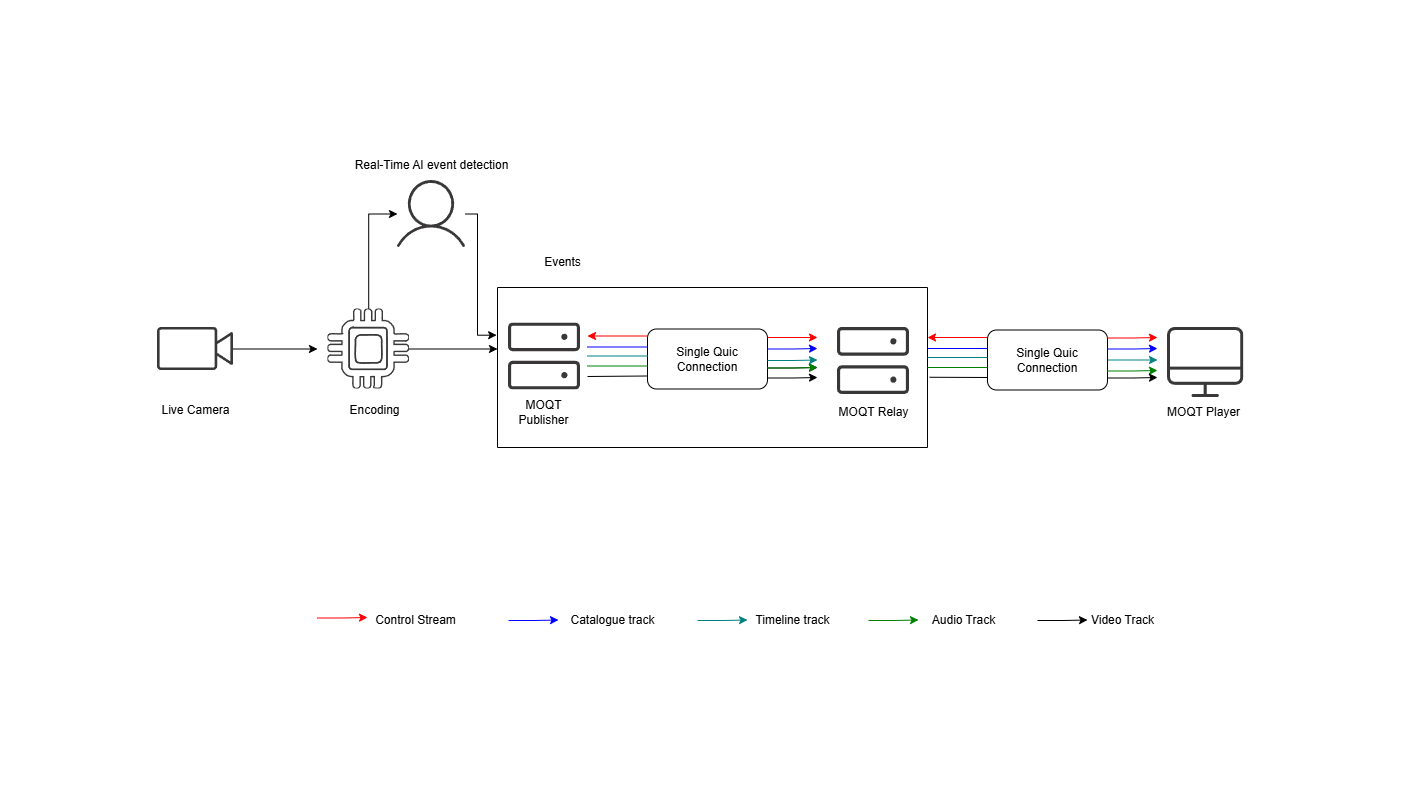
How MOQ Streaming Works
FAQs
/
What is Media over QUIC protocol?
Media over QUIC or MOQ is a next-generation streaming protocol that combines sub-second ultra-low latency at broadcast scale with architectural simplicity and transport efficiency.
/
Are there any available examples of MOQ protocol implementations?
Yes, you can try the MOQtail demos or set up your own MOQ streaming with Red5 Pro or Red5 Cloud. See the information above for details.
/
How does MOQ compare to WebRTC and HLS for latency and scalability?
MOQ bridges the gap between WebRTC’s near real-time latency and HLS’s scalability. Features that our customers already rely on, such as multi-view, clipping, and DVR-style scrubbing, could all run under a single protocol instead of switching between WebRTC for live and HLS for replays.
/
What MOQ players are currently available or in development?
At present we’re aware of six initiatives that have produced or are close to completing MOQ players. These include Moq-js, the player for MOQ Lite, Moq-encoder-player by Meta, Player Web X by Bitmovin, MOQtail by Professor Ali C. Begen and his students from Özyeğin University, WARP Player by Eyevinn Technology, and Shaka Player by Álvaro Velad Galván and Wojciech Tyczyński. It’s important to note that we have developed Playa, a modularly flexible template MOQ service providers can use to build players suited to their needs.
/
Does Red5 support ad insertion for MOQ streaming?
We are actively working on this area with partners such as Showfer Media, integrating ad workflows into real-time streaming pipelines. The goal is to help MOQ evolve from experimental deployments into production-ready systems. If you are interested in learning more or exploring early use cases, reach out to us.
/
Does Red5 support ad insertion for MOQ streaming?
We are actively working on this area with partners such as Showfer Media, integrating ad workflows into real-time streaming pipelines. The goal is to help MOQ evolve from experimental deployments into production-ready systems. If you are interested in learning more or exploring early use cases, reach out to us.
/
What types of applications benefit most from MOQ streaming?
Applications that combine live and on-demand streaming can benefit significantly from MOQ. Examples include live sports, betting, fan engagement platforms, surveillance and monitoring, gaming, news broadcasting, immersive AR/VR experiences, and more.
/
Is MOQ a superior alternative to WebRTC for real-time streaming?
MOQ isn’t a direct replacement for WebRTC. They can and should coexist in the live streaming space. Read our blog “MOQ vs WebRTC” to learn more.
/
Does Red5 support MOQ streaming?
Yes. MOQ support launched in Red5 Pro v15.4.0, allowing users to use MOQ as an egress protocol and connect it to the CDN of their choice for global scalability. Red5 Cloud also launched MOQ support in a limited beta, giving customers access to a fully managed, end-to-end, production-ready solution operating at global scale and powered by CacheFly’s CDN.
/
Is ad insertion supported in MOQ streaming today?
As we described in our recent blog, for MOQ to be viable in real production environments, monetization through ad insertion must also work. As of April 2026, there are no production-ready solutions available. However, Gwendal Simon from Synamedia and Will Law from Akamai Technologies demonstrated how MOQ and MSF can carry SCTE-35 signaling for Server-Guided Ad Insertion and regional blackout enforcement at the IETF MOQ interim in February 2026.
/
Has MOQ started moving from demos to practical implementations?
Yes. NAB Show 2026 showed a clear shift from early experimentation toward practical implementation. Multiple companies demonstrated working MOQ-based workflows, relay systems, playback solutions, interoperability tests, and scalable delivery architectures. The industry is still defining standards and best practices, but MOQ is no longer just a future concept. Real deployments, tooling, and production-focused discussions are actively happening across the ecosystem.
Want to Test MOQ Streaming with Your Application?
Not sure what solution would solve your streaming challenges best?
Watch our Youtube video explaining the difference between Red5 Pro and Red5 Cloud, check out the product comparison page, or reach out to us to discuss your case.